
The AI finance app market is bigger and noisier than it has ever been. Every second tool has “AI” somewhere in its name, its tagline, or its App Store listing. Some of those tools are genuinely useful. Others are dashboards with a chat box that produces generic responses unconnected to your actual accounts.
Before you hand over your bank connection, your email address, and ideally several minutes of your time each week, it is worth knowing what actually separates a capable AI finance app from one that will sit unopened on your phone within a month.
This guide covers the specific features to check, the questions to ask, and the warning signs to walk away from — all before you download anything.
Why App Store Ratings Do Not Tell You What You Need to Know
Most people pick a finance app the way they pick any app: search, look at the star rating, read two or three reviews, and download the one that seems most popular or most recently updated.
That process works fine for a productivity app or a game. It works poorly for an AI finance app, because the things that matter most — whether the AI is actually grounded in your connected account data, whether the connection is genuinely read-only, whether the privacy policy clearly says your data is not sold — are almost never captured in a star rating or a short review.
A five-star review does not tell you whether the AI observations are based on your real connected data or produced generically. It does not tell you whether the app monetises your transaction history. It does not tell you whether the “AI insights” are meaningful observations from connected account data or recycled tips dressed up with your balance attached.
The only way to evaluate an AI finance app properly is to know what to look for before you look.
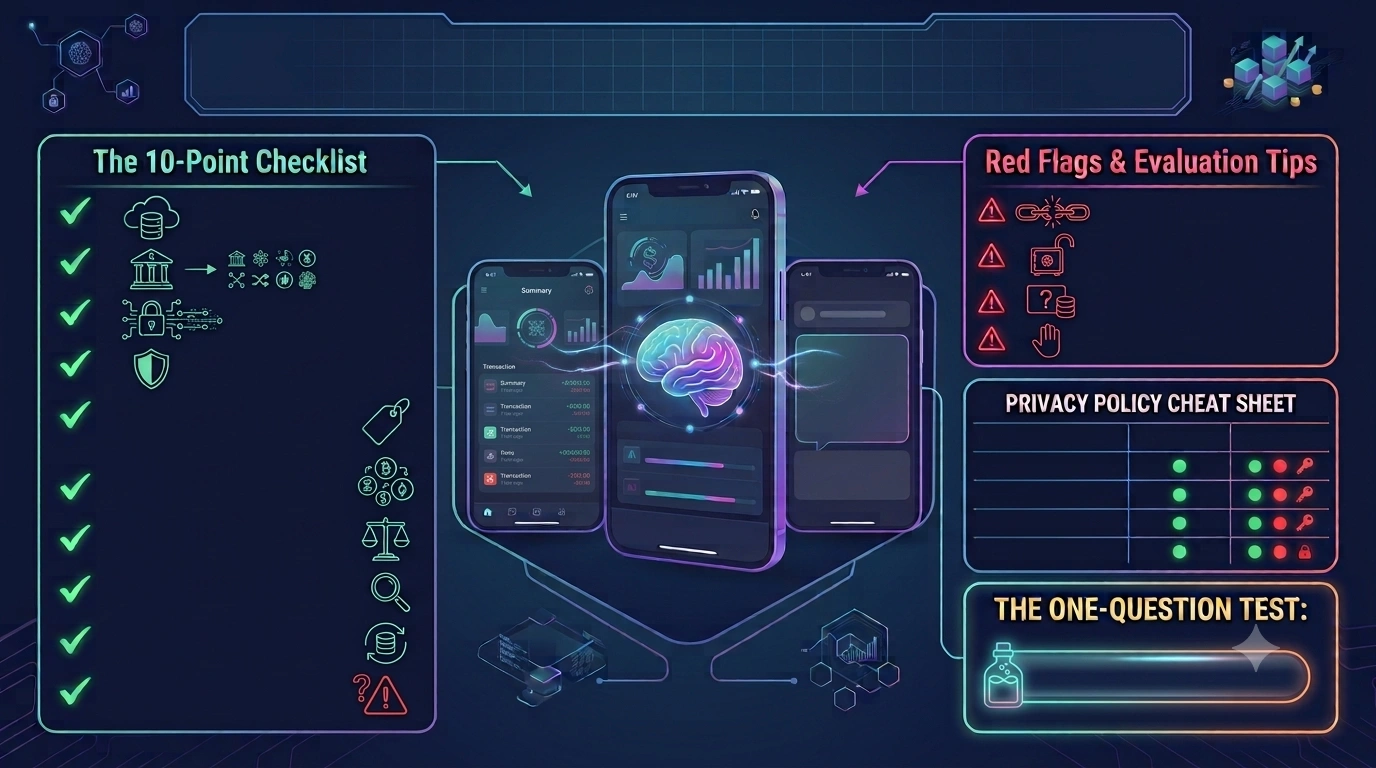
The Pre-Download Checklist: Key Features to Check
Work through these before committing to any AI finance app. Most can be checked on the app’s website or in its App Store listing. Some require a brief read of the privacy policy. A few require a short free trial.
• The AI produces observations from your actual connected account data — not generic responses
This is the single most important distinction in the category. A genuine AI finance app connects to your actual accounts and responds based on what is in your connected data. A chatbot finance app generates plausible-sounding responses that have nothing to do with your specific situation. The test: during any free trial, connect your accounts and ask something specific — ‘How much did I spend on subscriptions last month?’ If the answer is accurate to your real connected transactions, you have a connected AI. If the answer is a general tip about managing subscriptions, you have a chatbot with branding. All genuine AI observations should be informational only.
• Account coverage matches your actual financial life
Marketing pages often show logos for every major bank and institution. The reality is usually more limited. Check specifically: Does it support your bank? Your investment platform? If you hold crypto, does it connect to the exchange you actually use, and does it support wallet address tracking for on-chain holdings? For a tool to give you a connected picture of your financial position, it needs to connect to everything relevant to you, not just the accounts it shows in demo screenshots.
• Connections are read-only
Any reputable AI finance app uses read-only connections. This means the app can see your balances and transactions from connected accounts but cannot move money, execute trades, or make payments. This is the security standard you should expect, and it is worth confirming explicitly before connecting. For bank accounts in the US, look for Plaid or a similar open banking connection. For crypto exchanges, look for API key connections with view-only permissions and no trading or withdrawal rights. If the app asks for your full banking login credentials directly rather than routing you through a secure intermediary, that is a serious concern.
• The privacy policy clearly addresses data selling and sharing
AI finance apps handle some of the most sensitive personal data that exists. Before connecting anything, check the privacy policy specifically for: Does the company sell or share your financial data with third parties? What data is retained if you cancel? How is your data used? A company that handles your data responsibly will answer these questions clearly. Vague language around ‘partners’ and ‘service improvement’ without specifics is a reason to read more carefully or look elsewhere.
• Pricing is transparent and the free tier is genuinely evaluable
Many AI finance apps have a free tier too limited to tell you whether the paid product is worth it. Before downloading, check: How many accounts can you connect on the free plan? Do AI features from connected data work on the free tier, or are they paywalled? Is there a meaningful free trial of the paid tier? A good rule: if the free tier does not let you connect your real accounts and ask real questions about connected data, you cannot properly evaluate the tool. Look for apps that give you a meaningful trial on the full product.
• Crypto support covers your actual holdings
Most AI finance apps were built for traditional bank and investment accounts and added crypto as an afterthought, if at all. If you hold crypto, check specifically: Does it support the exchanges you use? Does it track wallet balances via public address? Does it handle multi-chain holdings? Does it calculate cost basis from connected transaction data? A tool that shows a price without knowing your actual connected position, or that misses your wallet holdings entirely, is not tracking your financial picture accurately. Cryptocurrencies and other digital assets are highly volatile and connected values will fluctuate.
• Liabilities are included, not just assets
Net worth is assets minus liabilities. An app that tracks your bank balance and investments but ignores your credit card debt, mortgage, and loans produces a number that flatters your actual position. Before connecting, check whether the app supports liability accounts: credit cards, loans, mortgages. If the answer is no, any net worth figure it produces from connected data is incomplete.
• AI observation quality is specific, not generic
Some apps generate AI ‘insights’ that sound analytical but are actually generic. ‘Your spending was higher this month’ is not useful. ‘Your dining spending from connected accounts increased 38% against your three-month average’ is closer to uuseful—butonly if it is grounded in your actual connected data. During any trial period, look at the quality of what the app surfaces unprompted. Are the observations specific to your connected data? Do they tell you something you did not already know? Do they hold up when you check them against your actual transactions? Shallow observations are the most common disappointment in this category. Remember: all AI observations should be informational only.
• Connection errors are flagged, not silently ignored
Data feeds break. Banks change APIs. Connections lapse. A good AI finance app flags this clearly when it happens, rather than silently serving you a figure from connected data that is days or weeks out of date. Check user reviews specifically for mentions of sync issues, stale data, or connections dropping without notification. An app that presents outdated connected account data as current is worse than no data at all for financial awareness.
• The app is clear about what its AI cannot do
A well-built AI finance app is honest about its limits: it does not provide financial advice, it does not predict market movements, and it does not make decisions on your behalf. Any app that implies its AI will tell you what to invest in, guarantee outcomes, or manage your money autonomously is either overpromising or describing a fundamentally different — and riskier — category of product. Look for this disclosure in the onboarding flow or terms of service. Its presence signals a responsibly built product. Its absence is a reason to look more carefully.
Red Flags: Walk Away if You See These
The checklist above covers what to look for. These are the specific signals that should make you pause or walk away entirely.
The app asks for your banking username and password directly
Legitimate apps connect via secure intermediary services that authenticate with your bank without the app ever seeing your credentials. If an app is asking for your actual login details directly, that is a non-starter regardless of any other features it offers.
The marketing promises specific financial outcomes
No AI finance tool can guarantee you will save more, earn more, or improve your financial position. Claims that imply otherwise — ‘grow your wealth automatically’, ‘let AI manage your money’, ‘see guaranteed results’ — are either misleading or describing a regulated financial service that requires appropriate licensing.
AI observations are generic, not grounded in your connected data
The most common form of overpromising in this category. The app presents a conversational AI that delivers confident-sounding responses — but those responses are not drawn from your connected account history. The test is always the same: ask something specific about your own accounts and check whether the observation is accurate to your connected data.
The privacy policy is vague about data sharing with partners
If the privacy policy uses phrases like ‘we may share your information with trusted partners’ without specifying who those partners are or what they do with the data, that vagueness is intentional. Your financial transaction history from connected accounts is valuable data. A company that handles it responsibly will be specific about how.
There is no clear process for deleting your account and data
You should be able to close your account and request deletion of your personal data. If the app does not have a visible account deletion process and a clear data deletion policy, that is a concern worth taking seriously before connecting.
The free tier cannot be meaningfully evaluated before purchase
If the app requires payment to connect more than one account, use AI features from connected data, or see anything beyond a login screen, you are being asked to buy before you can evaluate. Legitimate apps let you test their core value proposition before charging for it.
Questions to Ask During Any Free Trial
If an app offers a free trial, use it as a genuine evaluation, not just a test drive. These specific tests will tell you more about the tool than any marketing page.
Connect your real accounts and ask something specific
Do not test with dummy data. Connect your actual bank account and ask: “How much did I spend on food last month?” or “What are my biggest recurring charges?” The observation should be accurate to your real connected transactions. If it is vague or generic, the AI is not grounded in your connected data in a meaningful way.
Ask about something you already know the answer to
Before the trial, check your bank statement manually for one specific figure — total dining spend, total subscriptions, whatever is easy to verify. Then ask the AI the same question about your connected accounts. If the figures do not match, you have a data accuracy problem that will affect every observation the tool surfaces from connected data.
Check how the app handles a transaction it might miscategorise
Find a transaction in your history that is ambiguous — a pharmacy that also sells food, a merchant with an unintuitive name, a transfer between your own accounts. Check how the app categorises it from connected data. Correct it if it is wrong, then check whether the correction is reflected in subsequent observations.
Test the connection quality after a few days
Return to the app two or three days after connecting your accounts. Are the balances from connected accounts still current? Have any connections dropped? How does the app communicate if something is out of sync? A tool that silently serves stale connected data is a more significant problem than one that clearly flags a connection error.
Look at what the AI surfaces without being asked
A capable AI finance app does not just answer questions — it proactively surfaces observations about your connected spending patterns, unusual charges, and changes in your connected financial picture. What does the app show you on the home screen? Is it specific and grounded in your connected account data, or does it feel like it could have been written without knowing anything about you? All such observations should be informational only.
The Privacy Policy: What to Actually Read
Privacy policies are long. Here is the short list of what actually matters for an AI finance app.
| What to look for | Green signal | Red signal |
| Data sharing | Named, specific partners with stated purpose | ‘Trusted third parties’ with no further detail |
| Data sale | Explicit statement: we do not sell your data | No clear statement, or opt-out only after the fact |
| Data retention | Clear deletion timeline on account closure | Vague: ‘we may retain data for business purposes’ |
| AI training use | Your data is not used to train models without consent | No mention of AI training use at all |
| Security | Encryption at rest and in transit | No security detail provided |
| Account deletion | Self-serve deletion available in app settings | Must contact support, or no process described |
You do not need to read the whole policy. Search for the words ‘sell’, ‘share’, ‘partners’, ‘training’, and ‘delete’. The sentences around those words will tell you most of what you need to know.
Matching the Right App to Your Actual Situation
The best AI finance app is the one that fits your specific financial life, not the one with the most features or the most polished marketing.
If you hold crypto alongside traditional accounts
Most apps do not handle this well. Prioritise tools that were built with crypto as a first-class feature, not an afterthought. Check specifically for wallet address tracking, exchange API connections with read-only permissions, multi-chain support, and cost basis calculation from connected transaction data.
If your main goal is understanding your spending from connected accounts
Look for granular transaction categorisation from connected data, the ability to ask natural language questions about specific connected categories, and proactive observation detection. The quality of AI observations from connected spending data matters more than portfolio tracking features you will not use.
If you want a complete connected net worth picture
Prioritise breadth of connections: bank accounts, investment accounts, pension or retirement accounts, property (even as a manual entry), and all liability accounts. An incomplete connection set produces a misleading net worth figure.
If you are starting completely from scratch
Prioritise ease of onboarding and a clear interface over feature depth. The best app for a beginner is the one they will actually use consistently. The most powerful tool that gets abandoned after two weeks because it felt overwhelming serves no one.
If you manage finances as a household
Check whether the app supports multiple users or shared account views. Some tools are built as single-user products and handle shared finances poorly. Others are specifically designed for household use.
The One-Question Test for Any AI Finance App
If you take nothing else from this guide, take this:
Connect your real accounts. Ask one specific question about your own connected financial data. Check whether the observation is accurate to your connected accounts. That single test tells you more than any marketing claim, star rating, or feature list.
An AI finance app that is grounded in your connected accounts and surfaces informational observations that are true to your situation is worth exploring. One that generates plausible-sounding responses disconnected from your real connected data is noise dressed up as observation.
The tools that pass this test are worth your time. The ones that do not have told you something useful about themselves before they cost you anything.
The Honest Summary
The AI finance app market has genuinely capable products in it, and a lot of noise around them. The pre-download checklist in this guide gives you a structured way to separate one from the other before you hand over your financial account access.
The most important checks are: does the AI surface observations from your connected account data, is the connection read-only, and does the privacy policy clearly state what happens to your information. Everything else builds on those three foundations.
Take the trial period seriously. Use it as a real evaluation with real accounts and real questions. The app that passes that test is worth paying for. The one that does not has told you something useful about itself before it cost you anything. All AI-generated observations from any finance app are informational only and should not be interpreted as personalised financial advice.
Frequently Asked Questions
What key features should I check before downloading an AI finance app?
The most important features to verify before downloading are: whether the AI surfaces observations from your actual connected account data (not generic responses), whether connections are read-only so the app cannot move your money, what the privacy policy says about data sharing and selling, whether it supports all the account types relevant to you including crypto if applicable, and whether there is a meaningful free trial to evaluate the tool before paying.
How can I tell if an AI finance app is actually using my connected account data?
Connect your real accounts and ask a specific question you already know the answer to — such as your exact spending in a particular category last month. If the observation matches your real connected transaction history, the AI is grounded in your connected data. If the response is vague, generic, or inaccurate, the tool is not generating observations from your actual connected accounts.
Is it safe to connect my bank account to an AI finance app?
Reputable apps connect via secure services like Plaid that use read-only access — the app can see your connected account data but cannot move money or log in to your bank independently. You should never share your actual banking username and password with a finance app directly. Always confirm that the connection method is read-only before linking any account.
What does the privacy policy of a finance app tell me?
The most important sections cover whether the company sells or shares your financial data with third parties, how long your data is retained after account closure, whether your data is used to train AI models, and how you can request deletion of your account and data. Vague language around ‘trusted partners’ or ‘service improvement’ without specifics is a reason to read more carefully or look elsewhere.
Should I use a free or paid AI finance app?
Free tiers are useful for evaluation but are often too limited to be a complete long-term tool. Most meaningful AI features — full account connectivity, observations from connected data across all account types, and conversational AI grounded in your actual accounts — are available on paid plans. Look for apps with a meaningful free trial of the paid tier rather than a permanently limited free account.
What are the red flags to watch out for in an AI finance app?
Walk away if the app asks for your banking username and password directly, if the marketing promises specific financial outcomes or implies the AI will manage your money autonomously, if AI observations are clearly generic rather than based on your connected accounts, if the privacy policy is vague about data sharing with third parties, or if there is no clear process for deleting your account and data.
Disclaimer
This article is for general informational and educational purposes only. It does not constitute financial advice, investment advice, legal advice, or any form of personalised financial guidance. References to app features, pricing, and practices reflect publicly available information as of July 2026 and are subject to change. Always verify current details directly with the relevant provider before making a decision.
AI-generated observations and insights from finance apps are informational only and should not be interpreted as personalised financial advice or recommendations to buy, sell, or hold any asset. AI responses are generated from connected account data and may be affected by incomplete, delayed, or inaccurate information from connected sources.
Cryptocurrencies and other digital assets are highly volatile and may experience significant price fluctuations over short periods. AI financial assistants are organisational and analytical tools. They do not manage assets, execute transactions, or provide personalised financial recommendations. For advice tailored to your personal financial situation, consult a licensed financial advisor or qualified professional in your jurisdiction.