
Quick Answer
To calculate your total assets, list everything you own that has financial value and find a current figure for each. This includes cash and bank balances, brokerage and retirement accounts, cryptocurrency holdings, the estimated current market value of property, vehicle current market value, and any other assets with meaningful worth. Add the figures together. Total assets is one half of the net worth calculation; the other half is total liabilities. If you have a mortgage, that is treated as a liability and subtracted separately.
Net worth is assets minus liabilities. Before you can do that subtraction, you need an accurate total for the assets side. That means knowing what counts as an asset, finding a current value for each one, and making sure nothing significant is missing.
This is more involved than it sounds for most people, because financial assets are rarely all in one place. A checking account lives at one bank. A retirement plan lives at an employer or a separate provider. Cryptocurrency might sit on an exchange, in a hardware wallet, or across multiple chains. Each of these needs a current figure before the total means anything.
This article walks through every major asset category, explains how to value each one, and flags the items that are most commonly left out.
What Counts as an Asset
An asset, for the purpose of calculating personal net worth, is anything you own that has a measurable financial value and could, in principle, be converted to cash. The definition is broad enough to include obvious things like a bank balance and less obvious things like the current equity in a home or the value of a vehicle you have nearly finished paying off.
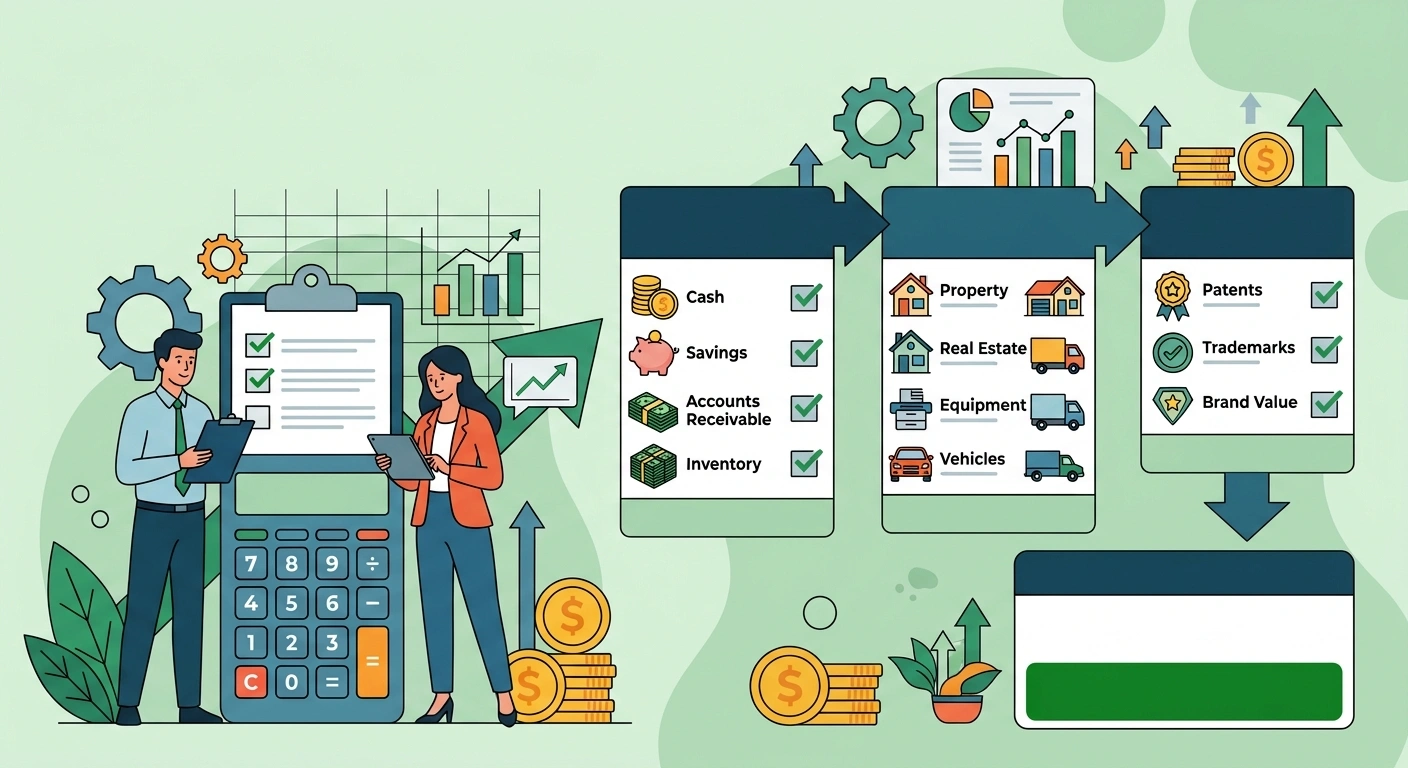
Assets are typically grouped into three categories: liquid assets that are already in cash or very close to it, financial accounts holding investments of various kinds, and physical assets with a market value. All three belong in the total.
The Asset Categories and How to Value Each One
• Cash and bank accounts
Includes: checking accounts, savings accounts, money market accounts, cash held physically
How to value it: Use the latest available balance shown in the account. For accounts where data is retrieved through a connected finance app, the figure reflects the latest available balance from that connection as of the most recent sync. For cash held physically, count it or estimate it and enter it manually.
• Brokerage accounts
Includes: Stocks, exchange-traded funds, mutual funds, bonds held in a taxable brokerage account
How to value it: Use the current market value of all holdings as shown in the account, not the amount originally invested. Market values fluctuate and a figure from a week ago may be meaningfully different from today. For connected accounts, available balance data is retrieved from the connection and reflects the most recent sync.
• Retirement accounts
Includes: 401k, IRA, Roth IRA, 403b, pension accounts
How to value it: Use the current account balance shown in the account statement or online portal. For a 401k or similar defined contribution plan, this is the market value of the holdings in the account. For a defined benefit pension, calculating a present value is more complex and may require a figure from your pension provider. Note that retirement account balances are pre-tax in most cases, so the actual spendable value after taxes would be lower, though most personal net worth calculations use the gross balance.
• Cryptocurrency
Includes: Bitcoin, Ethereum, and other digital assets held on exchanges or in self-custody wallets
How to value it: Use the current market value of your holdings, calculated as the number of units held multiplied by the current market price. For exchange-held crypto, a connected finance app using a read-only API key can retrieve available balance data from the exchange. For self-custody wallets, available balance data can be retrieved using your public wallet address. Cryptocurrency values are highly volatile and can change significantly in a short period. Any figure should be understood as reflecting available price data at the time it was retrieved.
• Property
Includes: Primary residence, second properties, land
How to value it: WealthNX currently does not retrieve property values through a live connected-account data feed. The figure requires an estimate of the current market value. This can be based on recent comparable sales in the area, an automated valuation from a property data service, or a formal appraisal. The value used is the estimated current market value of the property, not the original purchase price. If you have an outstanding mortgage, that balance is recorded separately as a liability on the other side of the net worth calculation.
• Vehicles
Includes: Cars, motorcycles, boats, recreational vehicles
How to value it: Use the current market value, not the original purchase price. Standard vehicle valuation tools such as those provided by automotive reference services give an estimated current value based on make, model, year, and condition. Vehicles depreciate over time, so a figure entered once and left unchanged will overstate the actual value. Periodic updates keep this figure closer to reality.
• Other assets
Includes: Business equity, collectibles, jewellery, intellectual property with commercial value, loans owed to you
How to value it: Valuing non-standard assets requires judgement. Business equity can be estimated based on revenue multiples, asset values, or a formal valuation if available. Collectibles and jewellery are valued at estimated current market value, which may require a professional appraisal for significant items. Loans owed to you by others are assets if they are genuinely expected to be repaid. Overstating the value of speculative or illiquid assets inflates the total without meaningfully improving the usefulness of the net worth calculation.
Assets That Are Commonly Left Out
These are the items that do not make it into the asset total as often as they should, either because they are easy to forget or because valuing them feels uncertain.
| Commonly missed asset | Why it gets overlooked | How to include it |
| Old 401k from a previous employer | Out of sight since changing jobs | Log in to the old plan provider or track it down through your previous employer’s HR records |
| Cryptocurrency in a self-custody wallet | Not visible in a standard brokerage or bank account | Use the public wallet address with a connected finance app or manually calculate units times current market price |
| Property / current market value | No automatic connection available; estimated market value feels uncertain to enter | Estimate current market value using comparable sales or an automated valuation tool. Enter the full estimated market value as the asset. Any outstanding mortgage is recorded separately as a liability. |
| Vehicle current market value | People forget to include it or use the purchase price rather than current value | Look up current market value using a standard automotive reference tool and update periodically |
| Health savings account balance | Treated as a spending account rather than an asset | The balance in a health savings account is yours and counts as an asset |
| Refundable deposits | Feels too temporary to count | A rental security deposit or a utility deposit you expect to get back is technically an asset, though small in most cases |
Step-by-Step: Calculating Your Total Assets
Step 1: List every account and asset you own
Start by writing down everything, without worrying about current values yet. Bank accounts, brokerage accounts, retirement accounts from all employers past and present, cryptocurrency held anywhere, property owned, vehicles, and any other items of meaningful value. Getting the list right matters more than any individual figure.
Step 2: Find a current value for each item
Work through the list and find a current value for each entry. For connected accounts, use the latest available balance from each connection. For property and vehicles, use an updated market estimate rather than the original purchase price. For cryptocurrency, multiply units held by the current market price at the time of calculation, noting that this figure may change quickly.
Step 3: Note which figures are estimates
Some asset values are precise, such as a bank balance. Others are estimates, such as a property value or a collectible. Knowing which figures are estimates and which are precise helps you understand the confidence level of the total. A net worth calculation that includes a property valued at a rough estimate has a wider margin of uncertainty than one where property values are based on a recent formal appraisal.
Step 4: Add them all together
Total assets is the sum of all the individual asset values. This is one half of the net worth calculation. The next step is calculating total liabilities and subtracting that figure from total assets to arrive at net worth.
How to Calculate Total Assets Using WealthNX
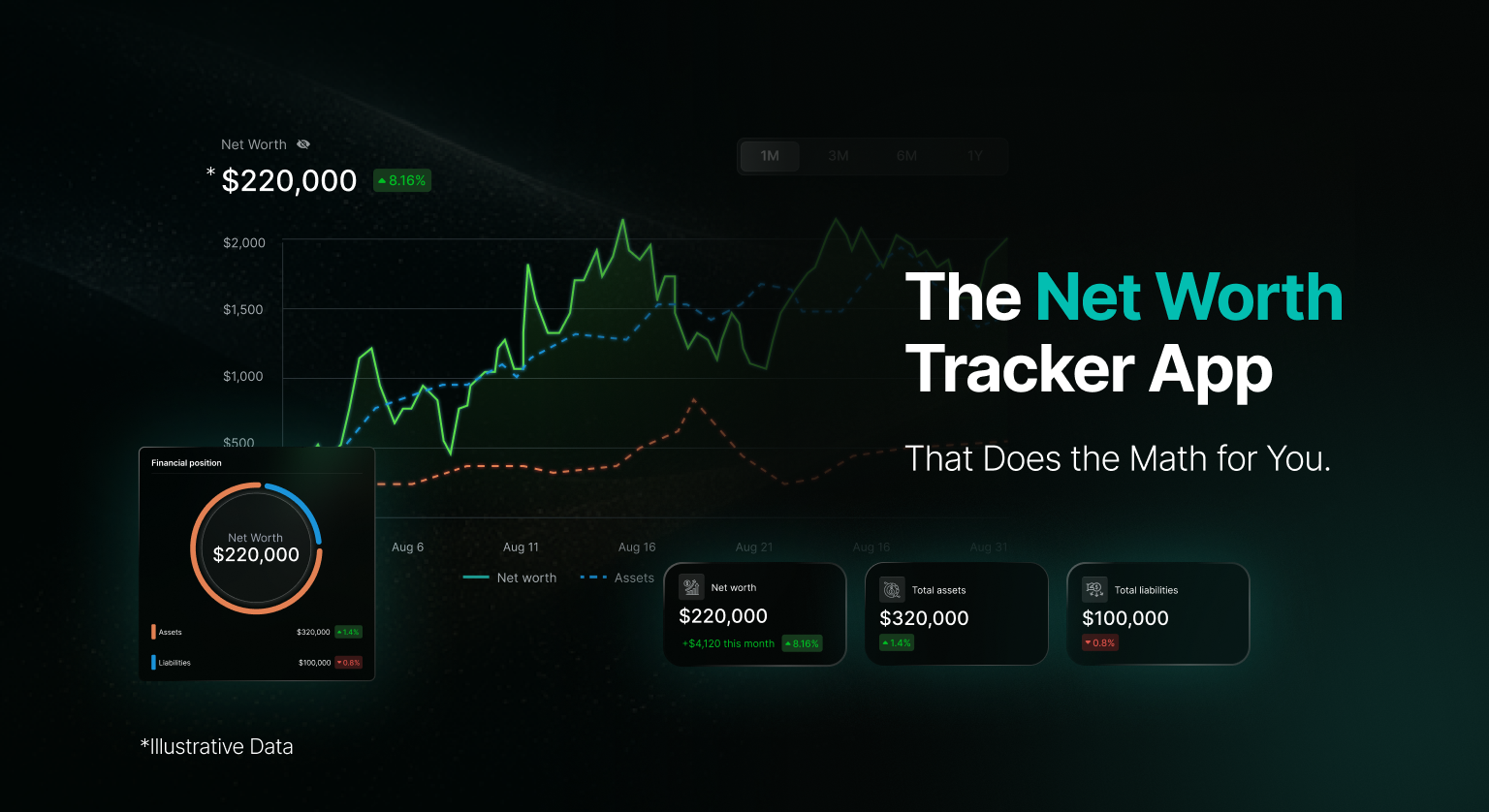
WealthNX is designed to bring the asset calculation process together in one place, reducing the need to separately review and manually record information from supported connected accounts. Here is how each asset category is handled.
Bank and brokerage accounts
WealthNX can connect to supported bank and brokerage accounts through read only connections and retrieves available account data, including balances and holdings as applicable, from supported connected accounts. Once connected, the latest available balance and holdings data is accessible from within the app without requiring manual entry for each supported account. The figures reflect available data from each connection at the time of the most recent sync.
Retirement accounts
Where supported retirement accounts can connect directly, WealthNX retrieves available balance data from those connections. For retirement accounts at providers that do not support a direct connection, the balance can be entered manually where the manual entry feature is supported, and updated periodically as new statements are available.
Cryptocurrency
For cryptocurrency held on supported exchanges, WealthNX uses read-only API keys to retrieve available balance and holdings data without any trading or withdrawal permissions. For self-custody wallets, public wallet addresses can be added to retrieve available on-chain balance data. The AI assistant can surface informational observations about cryptocurrency holdings as part of the connected asset view. Cryptocurrency values are highly volatile and any figures reflect available price data at the time of the most recent sync.
Property and vehicles
WealthNX currently does not retrieve property values or vehicle values through a live connected-account data feed. WealthNX supports manual entry of these figures where the feature is available, allowing property and vehicle values to be included in the total asset view alongside connected account data. These manually entered figures should be reviewed and updated periodically to reflect changes in market value.
Asking the AI assistant directly
Once your accounts are connected and manual entries are in place, the WealthNX AI assistant can answer plain-language questions about your total asset picture based on available data from your connected accounts. You can ask questions such as how your total connected assets have changed over a period, which account categories make up the largest share of your connected asset total, or how a specific account balance has moved over time. All responses are informational only and should not be interpreted as financial advice. Responses may be affected by incomplete, delayed, or unavailable data from connected accounts.
WealthNX brings together available data from connected bank, brokerage, and cryptocurrency accounts alongside manually entered figures for property and vehicles, giving you a consolidated asset view without logging in to each institution separately.
WealthNX holds ISO 27001 certification, the internationally recognised standard for information security management. WealthNX is the publisher of this article and references its own services where relevant.
Summary
Calculating total assets is a matter of identifying what you own, finding a current value for each item, and adding the figures together. Items that are often missing include retirement accounts from old employers, cryptocurrency in self-custody wallets, and property, where the estimated current market value requires a manual entry rather than a direct data feed. Closing those gaps produces a more complete picture, though the accuracy of the total depends on the quality of the individual estimates, particularly for assets like property and vehicles where market values change over time.
Total assets is one side of the net worth equation. Once you have it, subtracting your total liabilities gives you the net worth figure that actually tells you where you stand.
Frequently Asked Questions
Do I include my home’s full value as an asset?
Yes, the estimated current market value of your home is included as an asset. However, if you have an outstanding mortgage, that mortgage balance is a separate liability. The contribution of property to your net worth is the equity, which is the current market value minus the outstanding mortgage balance. Include the full property value on the asset side and the full mortgage balance on the liability side, and the net worth calculation will reflect the equity correctly.
Should I include retirement accounts in total assets?
Yes. Retirement accounts such as a 401k or IRA contain assets you own, even though the funds are subject to tax and withdrawal restrictions. The balance shown in the account is included on the asset side. The tax liability on future withdrawals is typically not subtracted in a standard personal net worth calculation, though it is worth being aware that the spendable value of a pre-tax account would be lower than the gross balance after taxes are applied.
How do I value cryptocurrency for a total assets calculation?
Calculate the current market value of your holdings by multiplying the number of units you hold by the current market price for each asset. Cryptocurrency prices are highly volatile and the figure will change frequently. Any value used should be understood as reflecting available price data at a specific point in time. A connected finance app that retrieves available data from your exchange through a read-only API key can surface this figure from available data without requiring manual calculation.
What if I am not sure of the current value of an asset?
Make a reasonable estimate and note that it is an estimate. A rough property value based on comparable local sales is more useful than leaving the property out entirely. A vehicle value from a standard automotive reference tool is more useful than using the original purchase price. The goal is a figure that is reasonably close to current market reality, updated periodically as values change.
Disclaimer
This article is for general informational and educational purposes only and does not constitute financial, tax, or legal advice. Asset valuation methods described are general educational guidance and may not be appropriate for all situations. WealthNX is the publisher of this article and references its own services where relevant. WealthNX holds ISO 27001 certification, the internationally recognised standard for information security management.
All AI generated observations provided by WealthNX are informational only and are not personalised financial advice. Responses are generated from available data from connected accounts and may be affected by incomplete, delayed, or unavailable data from connected accounts. Cryptocurrencies are highly volatile and values may change significantly in short periods. For advice tailored to your situation, consult a licensed financial advisor.