

Quick Answer
Tracking net worth across multiple accounts means connecting every relevant account, including bank accounts, brokerage accounts, retirement accounts, cryptocurrency holdings, and outstanding debts, into a single view that combines assets minus liabilities into one figure. The challenge is not the calculation itself. It is making sure every account that belongs in the picture is actually in it, on both the asset and the liability side.
Most people with any financial complexity have their money spread across several places. A checking account at one bank, a savings account somewhere else, a workplace retirement plan, maybe a brokerage account opened separately, and for a growing number of people, some amount of cryptocurrency. That is before considering what they owe: a mortgage, a car loan, a credit card or two.
Each of those accounts tells a partial story. The checking account tells you your day-to-day balance. The brokerage tells you your holding values. The credit card tells you what is owed this month. What none of them does on its own is answer the question that matters more than any individual balance: across everything, what is the overall position?
Tracking net worth across multiple accounts is how you get that answer. This article covers the practical steps to do it, the account types that tend to get left out, and how a connected finance tool can bring the pieces together in one view.
Why Multiple Accounts Make This Harder Than It Sounds
Adding up several account balances sounds simple. In practice, a few things make it more complicated than the arithmetic suggests.
The accounts are spread across institutions that do not communicate with each other. Your bank does not know what is in your brokerage account. Your brokerage does not know about your mortgage. There is no central system that holds all of this together unless you build one, either manually or through a connected tool.
The balances also change at different rates. A checking account changes every time a transaction clears. A cryptocurrency holding might move significantly in a single day. A mortgage balance decreases slowly with each payment. Manually updating a spreadsheet with current figures from all of these at the same time requires logging in to every institution separately, which is precisely the kind of friction that causes people to check in less frequently than they should.
The challenge of tracking net worth across multiple accounts is not the maths. It is the logistics of getting current figures from every relevant place at the same time.
What Needs to Be in the Picture
A net worth figure is only as useful as it is complete. These are the account types that belong on each side of the calculation.
On the asset side
• Checking and savings accounts from all banks you use
• Brokerage accounts holding stocks, funds, or ETFs
• Retirement accounts including 401k, IRA, and Roth IRA from current and previous employers
• Cryptocurrency holdings on supported exchanges and in self-custody wallets
• Property equity, calculated as estimated current market value minus outstanding mortgage balance
• Any other accounts or holdings with meaningful value
On the liability side
• Mortgage balance outstanding
• Car loans and personal loans
• Credit card balances
• Student loans
• Any other outstanding obligations
The accounts left out most often are old retirement accounts from previous employers, cryptocurrency wallet balances, and the liabilities side in general. A net worth calculation that omits significant debts does not show a complete net worth calculation. It shows gross assets.
Three Ways to Bring It All Together
A manually maintained spreadsheet
A spreadsheet with a column for each account, current balance entered by hand, and a formula subtracting liabilities from assets at the bottom gives a full net worth figure. It costs nothing beyond the time to build it, and it does not require sharing account data with a connected finance app. The limitation is maintenance: every figure needs to be updated manually, which requires logging in to each institution separately and entering the numbers. For anyone with more than a handful of accounts, this becomes increasingly time-consuming to keep current.
A dedicated net worth app with manual entry
Some apps allow you to set up an asset and liability structure and enter values manually without connecting to any external accounts. This gives an organised view without the privacy trade-off of a third-party connection. The accuracy depends entirely on how recently each figure was entered, which brings back the same maintenance question as a spreadsheet, in a slightly more structured format.
A connected finance app with read-only account access
A connected finance app retrieves available account data, including balances and holdings as applicable, from supported connected accounts through read-only access. This means the app can access financial information made available through the connection but cannot move funds or take any action on your accounts. For accounts that cannot connect directly, such as certain pension accounts or properties, manual entry is typically also available. When accounts are connected, the figures update from available data as those connections sync, without requiring manual input for each institution.
A Practical Checklist for Getting Started
| Step | What to do |
| List every account | Write down every financial account you hold, on both the asset and liability side, before connecting anything. |
| Connect bank accounts | Link checking and savings accounts through the app’s supported connection method. |
| Connect brokerage and retirement accounts | Include current employer plans and any accounts from previous employers. |
| Add cryptocurrency | For exchanges, use a read-only API key with no trading or withdrawal permissions. For wallets, add your public address. |
| Enter what cannot connect | Property equity, certain pensions, and loans at smaller institutions may need manual entry. |
| Check the liability side | Confirm all debt accounts are included. The figure is incomplete without them. |
| Review and update periodically | Connected accounts update from available data as connections sync. Manual entries need periodic review to stay current. |
How WealthNX Handles Multiple Accounts
WealthNX can connect to supported bank and brokerage accounts through read only connections and retrieves available account data, including balances and holdings as applicable, from supported connected accounts. Cryptocurrency holdings can be tracked through read-only API keys for supported exchanges and public wallet address monitoring for on-chain balances. Where direct connections are not available, financial information can also be added manually where the feature is supported.
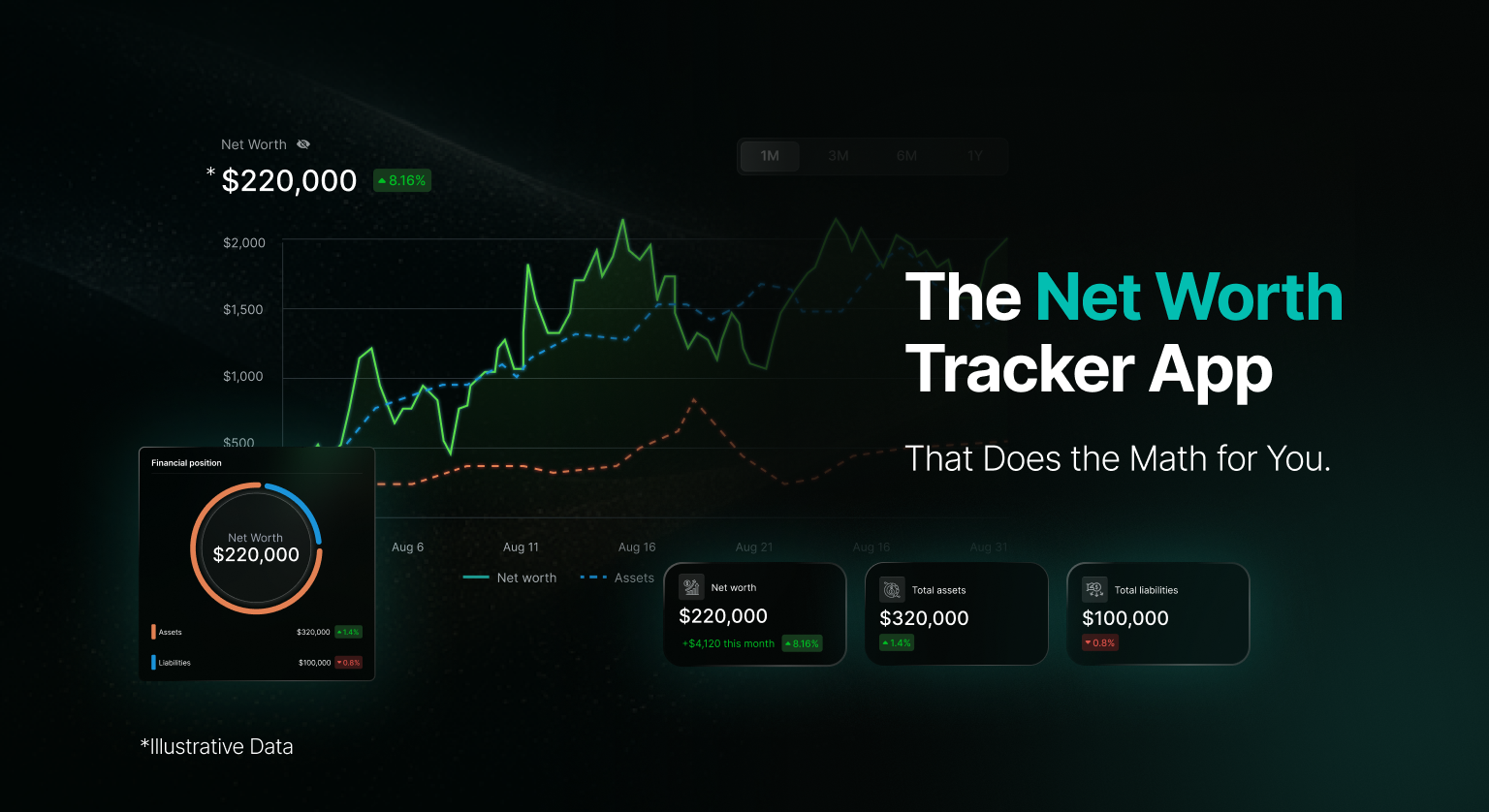
The result is a connected view of assets and liabilities from supported accounts alongside any manually entered figures, combined into a net worth figure that reflects available data across all connected sources. An AI assistant can surface informational observations about the connected financial picture and answer plain-language questions about balances, trends, and account data. All observations provided by WealthNX are informational only and should not be interpreted as financial advice. Responses may be affected by incomplete, delayed, or unavailable data from connected accounts. WealthNX holds ISO 27001 certification, the internationally recognised standard for information security management. WealthNX is the publisher of this article and references its own services where relevant.
The Honest Takeaway
Tracking net worth across multiple accounts is not technically difficult. The formula is assets minus liabilities. The practical challenge is getting all of the relevant accounts into the same view, on both sides, and keeping the figures current enough to be informative.
The most common gaps are a retirement account from an old employer that was never connected, cryptocurrency holdings that live outside the main tracking tool, and liabilities that were left out because connecting loan accounts felt like an extra step. Closing those gaps is what turns a partial picture into a useful one. Changes in net worth over time should be considered alongside the underlying accounts, liabilities, and other relevant financial circumstances.
Frequently Asked Questions
Do I need to include all my accounts to track net worth accurately?
The more complete the account list, the more the net worth figure reflects your actual financial position. Leaving out a significant asset understates the figure. Leaving out a significant liability overstates it. Neither gives a useful view. Including every relevant account, even smaller ones, produces a more accurate picture than a selective approach.
How do I include cryptocurrency when tracking net worth?
For exchange-held cryptocurrency, connect the exchange using a read-only API key generated in your exchange settings, with no trading or withdrawal permissions enabled. For self-custody wallets, provide the public wallet address to the app. The app can then retrieve available balance data from publicly accessible blockchain records. Cryptocurrency values are highly volatile and will fluctuate in any connected net worth view.
What if one of my accounts cannot connect to the app?
Most connected finance apps support manual entry for accounts that cannot connect directly. This is common for certain pension accounts, property equity, and loans at smaller institutions. Manually entered figures need to be reviewed and updated periodically to remain reasonably current.
Disclaimer
This article is for general informational and educational purposes only and does not constitute financial advice. WealthNX is the publisher of this article and references its own services where relevant. WealthNX holds ISO 27001 certification, the internationally recognised standard for information security management.
All AI generated observations provided by WealthNX are informational only and are not personalised financial advice. Responses are generated from available data from connected accounts and may be affected by incomplete, delayed, or unavailable data from connected accounts. Cryptocurrencies are highly volatile. For advice tailored to your situation, consult a licensed financial advisor.