
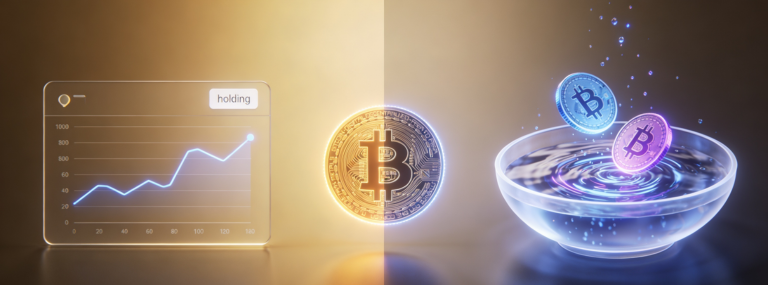
Impermanent loss vs holding is complicated.If you’ve explored decentralized finance (DeFi), you’ve probably heard about liquidity pools.
They sound like a great way to earn passive income. This includes deposits of your crypto, earn fees, and watch your holdings grow. But there’s a catch called impermanent loss that can quietly eat into your returns.
Understanding impermanent loss is essential before you provide liquidity to any decentralized exchange.
Let’s break down what it is, how it works, and why sometimes holding your tokens might be more profitable than providing them as liquidity.
What Is Impermanent Loss?
Impermanent loss occurs when the price of tokens in a liquidity pool changes compared to when you deposited them. The loss is “impermanent” because it only becomes permanent when you withdraw your tokens from the pool.
Here’s the thing: when you provide liquidity, you’re depositing two tokens into a pool (like ETH and USDC). The automated market maker (AMM) keeps these tokens balanced according to a mathematical formula. When prices shift, the ratio of tokens in your position automatically adjusts. This rebalancing can leave you with less value than if you had simply held the original tokens.
How Liquidity Pools Work
Decentralized exchanges like Uniswap and SushiSwap use liquidity pools instead of traditional order books. When you provide liquidity, you deposit an equal value of two tokens. For example, if you want to provide liquidity to an ETH/USDC pool, you might deposit $500 worth of ETH and $500 of USDC.
Traders swap tokens using these pools, and the AMM uses a constant product formula to determine prices. The most common formula is x × y = k, where x and y represent the quantities of each token, and k remains constant.
Every time someone makes a trade, the ratio of tokens in the pool changes. The pool automatically rebalances to maintain the constant product. This is where impermanent loss enters the picture.
Why Impermanent Loss Happens
When token prices move significantly in one direction, the AMM’s rebalancing mechanism works against you. The pool automatically sells your appreciating asset and buys more of the depreciating one to maintain balance.
Let’s say you deposit 1 ETH and 2,000 USDC when ETH is worth $2,000. If ETH’s price doubles to $4,000, the pool rebalances. You end up with less ETH and more USDC than you started with. While you’ve made some gains, you would have made more money by simply holding the original 1 ETH.
The bigger the price change, the greater the impermanent loss. This makes volatile token pairs particularly risky for liquidity providers.
A Real Example
Imagine you provide liquidity with $10,000 worth of tokens: 1 ETH ($5,000) and 5,000 USDC ($5,000).
If ETH’s price stays at $5,000, you’re fine. But if ETH rises to $10,000:
- Your original holding strategy would give you $15,000 (1 ETH worth $10,000 plus 5,000 USDC)
- As a liquidity provider, the pool rebalances to approximately 0.707 ETH and 7,071 USDC, totaling about $14,142
- Your impermanent loss is roughly $858, or 5.7%
The trading fees you earn might offset this loss, but in many cases, they don’t fully compensate for significant price movements.
When Does Impermanent Loss Matter Most?
Impermanent loss becomes more significant in several scenarios:
Volatile pairs: Tokens with high price volatility create more rebalancing and larger losses. Pairing two volatile tokens amplifies this effect.
One-directional price movements: When one token consistently moves up or down without reverting, impermanent loss accumulates steadily.
Low fee generation: If the pool doesn’t generate enough trading fees, those fees won’t compensate for the impermanent loss you experience.
Long holding periods with price changes: The longer prices stay diverged from your entry point, the more real your impermanent loss becomes.
Strategies to Manage Impermanent Loss
While you can’t eliminate impermanent loss entirely, you can manage your exposure:
Choose stable pairs: Providing liquidity to stablecoin pairs (like USDC/DAI) minimizes impermanent loss since prices rarely diverge significantly.
Look for high-fee pools: Pools with substantial trading volume generate more fees, which can offset impermanent loss.
Consider correlated assets: Pairs like ETH/stETH tend to move together, reducing the rebalancing effect.
Monitor positions regularly: Track your position’s performance compared to simply holding the tokens.
Calculate break-even points: Understand how much fee income you need to compensate for potential price divergence.
Getting Insights for Better Decisions
Understanding impermanent loss in real-time can be challenging. You need to track price movements, calculate potential losses, monitor fee generation, and compare different scenarios.
This is where platforms like WealthNX AI come into play. Rather than offering generic calculators, WealthNX AI provides personalized insights based on your specific positions and market conditions. The platform analyzes your liquidity positions, compares them against holding strategies, and presents data-driven insights about your actual performance.
Instead of manually calculating impermanent loss across multiple positions and protocols, WealthNX AI helps you understand the numbers quickly. You can see how different price scenarios might affect your positions and make informed decisions based on comprehensive data rather than guesswork.
The Bottom Line
Impermanent loss is a fundamental aspect of providing liquidity in DeFi. It’s not a fee or a penalty—it’s simply a mathematical consequence of how automated market makers work. Sometimes the trading fees you earn will outweigh the impermanent loss. Other times, you would have been better off holding your tokens.
The key is understanding when providing liquidity makes sense for your situation. Stablecoin pairs offer minimal impermanent loss but lower potential returns. Volatile pairs might generate higher fees but carry greater risk of loss.
Education and awareness are your best tools. By understanding how impermanent loss works and tracking your positions carefully, you can make better decisions about when to provide liquidity and when to hold your tokens instead.
Comparison Tables
Impermanent Loss by Price Change
Price Change | Impermanent Loss |
1.25x | 0.6% |
1.50x | 2.0% |
1.75x | 3.8% |
2x | 5.7% |
3x | 13.4% |
4x | 20.0% |
5x | 25.5% |
Holding vs. Providing Liquidity Example
Scenario | Initial Value | Final Value (HODL) | Final Value (LP) | Difference |
ETH stays $2,000 | $10,000 | $10,000 | $10,000 + fees | +fees |
ETH rises to $3,000 | $10,000 | $11,000 | $10,732 + fees | -$268 + fees |
ETH rises to $5,000 | $10,000 | $13,000 | $12,247 + fees | -$753 + fees |
ETH drops to $1,000 | $10,000 | $8,000 | $8,944 + fees | +$944 + fees |
Note: “LP” includes impermanent loss but fees may offset losses
Frequently Asked Questions
What exactly makes the loss “impermanent”?
The loss is called impermanent because it’s not realized until you withdraw your liquidity. If token prices return to their original ratio when you deposited, the impermanent loss disappears. However, if you withdraw while prices are different, the loss becomes permanent.
Can I ever lose all my money to impermanent loss?
No. Impermanent loss represents an opportunity cost compared to holding, not an absolute loss of funds. You’ll still have valuable tokens; you’ll just have less value than if you had held the original tokens. The maximum theoretical impermanent loss approaches 100% only if one token goes to zero.
Do I still earn trading fees with impermanent loss?
Yes. You continue earning a share of trading fees regardless of impermanent loss. In many cases, accumulated fees can partially or fully offset impermanent loss, especially in high-volume pools.
Which token pairs have the least impermanent loss?
Stablecoin pairs like USDC/USDT or DAI/USDC have minimal impermanent loss because their prices stay closely pegged. Correlated assets like ETH/stETH also experience less impermanent loss than completely uncorrelated pairs.
How can WealthNX AI help me understand my positions?
WealthNX AI provides personalized insights by analyzing your specific liquidity positions in real-time. Rather than using generic calculators, the platform shows you actual performance data, compares your positions to holding strategies, and helps you understand the numbers behind your DeFi activities.
Is providing liquidity always worse than holding?
Not necessarily. In stable or ranging markets with high trading volume, the fees earned can exceed impermanent loss, making liquidity provision profitable. The outcome depends on price movement, fee generation, and time horizon.
How often should I check my liquidity positions?
This depends on your strategy and the volatility of your pairs. For volatile pairs, checking weekly or even daily makes sense. For stable pairs, less frequent monitoring may suffice. Platforms that provide automated insights can help you stay informed without constant manual checking.
Can impermanent loss be positive?
Impermanent loss itself is always negative compared to holding, but your overall position can still be profitable when you include trading fees. If fees exceed the impermanent loss, your total return beats simply holding the tokens.
Conclusion
Impermanent loss represents one of the most misunderstood concepts in decentralized finance, yet it’s crucial for anyone considering liquidity provision. While the mathematics behind it can seem complex, the core principle is straightforward: automated market makers rebalance your position as prices change, which can leave you with less value than simply holding your original tokens.
This doesn’t mean providing liquidity is always a bad decision. High-volume pools can generate substantial trading fees that compensate for impermanent loss. Stablecoin pairs minimize the risk while still offering steady returns. The key is approaching liquidity provision with clear expectations and proper monitoring tools.
As DeFi continues to evolve, understanding these fundamental mechanics becomes increasingly important. Whether you’re providing liquidity to earn passive income or exploring different yield strategies, knowledge of impermanent loss helps you make informed decisions. Platforms like WealthNX AI are emerging to bridge the gap between complex DeFi mathematics and practical decision-making, providing the insights needed to navigate these waters effectively.
References
- Uniswap. (2021). “Uniswap v2 Core.” Uniswap Protocol Documentation. https://docs.uniswap.org/protocol/V2/introduction
- Adams, H., Zinsmeister, N., & Robinson, D. (2020). “Uniswap v2 Core Whitepaper.” Uniswap. https://uniswap.org/whitepaper.pdf
- Pintail. (2019). “Understanding Uniswap Returns.” Medium. https://medium.com/@pintail/understanding-uniswap-returns-cc593f3499ef
- Martinelli, F., & Mushegian, N. (2019). “Balancer Whitepaper.” Balancer Labs. https://balancer.fi/whitepaper.pdf
- Zhang, Y., Chen, X., & Park, D. (2021). “An Empirical Study on Ethereum DeFi: Impermanent Loss.” arXiv preprint arXiv:2106.06389.
- Curve Finance. (2020). “StableSwap – Efficient Mechanism for Stablecoin Liquidity.” Curve Documentation. https://curve.fi/files/stableswap-paper.pdf
- Gudgeon, L., Perez, D., Harz, D., Livshits, B., & Gervais, A. (2020). “The Decentralized Financial Crisis.” IEEE Symposium on Security and Privacy.
- Heimbach, L., & Wattenhofer, R. (2021). “Eliminating Sandwich Attacks with the Help of Game Theory.” arXiv preprint arXiv:2111.03322.
- DeFi Pulse. (2024). “Total Value Locked in DeFi.” https://defipulse.com/
- SushiSwap Documentation. (2024). “Liquidity Provider Guide.” https://docs.sushi.com/
- Bancor. (2020). “Bancor v2.1 Economic Analysis: Single-Sided Exposure & Impermanent Loss I
Sonnet 4.5