

Everyone has heard about AI assistants by now. Most of the conversation has been about writing emails faster or generating images. But a quieter category has been growing alongside all of that, AI built specifically around personal finance. Tools that connect to your accounts, read your money situation, and try to answer real questions about it.
The pitch sounds appealing. Ask a question and get a clear answer, skip the dashboard navigation. But a reasonable person should also ask: what does an AI financial assistant actually do when you put it in front of your real accounts?” Where does it help, where does it fall short, and how is it different from just Googling something?
This piece answers those questions plainly, without overselling what the technology can currently do.
The Core Idea: From Dashboard to Conversation
Traditional personal finance apps give you a dashboard. Charts, numbers, categories. The assumption is that you will look at the data, understand it, and draw your own conclusions.
The problem with that assumption is that most people are not trained to interpret financial dashboards. They open the app, see a lot of numbers, feel mildly anxious, and close it again. The information is technically there. Practically, it is not useful.
An AI financial assistant flips that model. Instead of presenting data and waiting for you to interpret it, it accepts questions and produces answers. “What did I spend on food last month?” gives you a number. “How does that compare to the month before?” gives you context. “Where is my money going that I probably do not need it to go?” is the kind of question a good AI assistant can actually work with.
That shift — from passive dashboard to active conversation — is what distinguishes AI financial assistants from earlier generations of finance apps.
What an AI Financial Assistant Can Actually Do
Here is a concrete breakdown of what the current generation of these tools does in practice.
Answer questions about your real accounts
This is the foundation. A genuine AI financial assistant is connected to your data — your bank accounts, your investment accounts, your crypto holdings — and responds based on what is actually in those accounts, not generic templates.
If you ask “how much did I spend on subscriptions this month?”, the answer should pull from your transaction history, identify recurrng charges, and give you a real number. Not an estimate. Your number.
This separates real AI financial assistants from chatbots that just happen to live inside a finance app.
Identify patterns you would not notice on your own
Spending patterns are hard to see in real time. Your coffee spending does not feel significant in the moment. Your subscription costs do not feel significant individually. But when an AI looks at twelve months of transactions and tells you that your recurring charges have grown 35% over the past year — that is useful information you were not going to find by scrolling through a bank statement.
This is where the “intelligent” part of the description earns its keep. Spotting patterns across large transaction histories is exactly the kind of task that works well for machine learning.
Explain what changed and why
Portfolio value went down. Spending went up. Net worth looks different than last month. A dashboard shows you the change. An AI financial assistant can explain it — what moved, what may have contributed to the shift, what the underlying data shows.
Track multiple asset types in one place
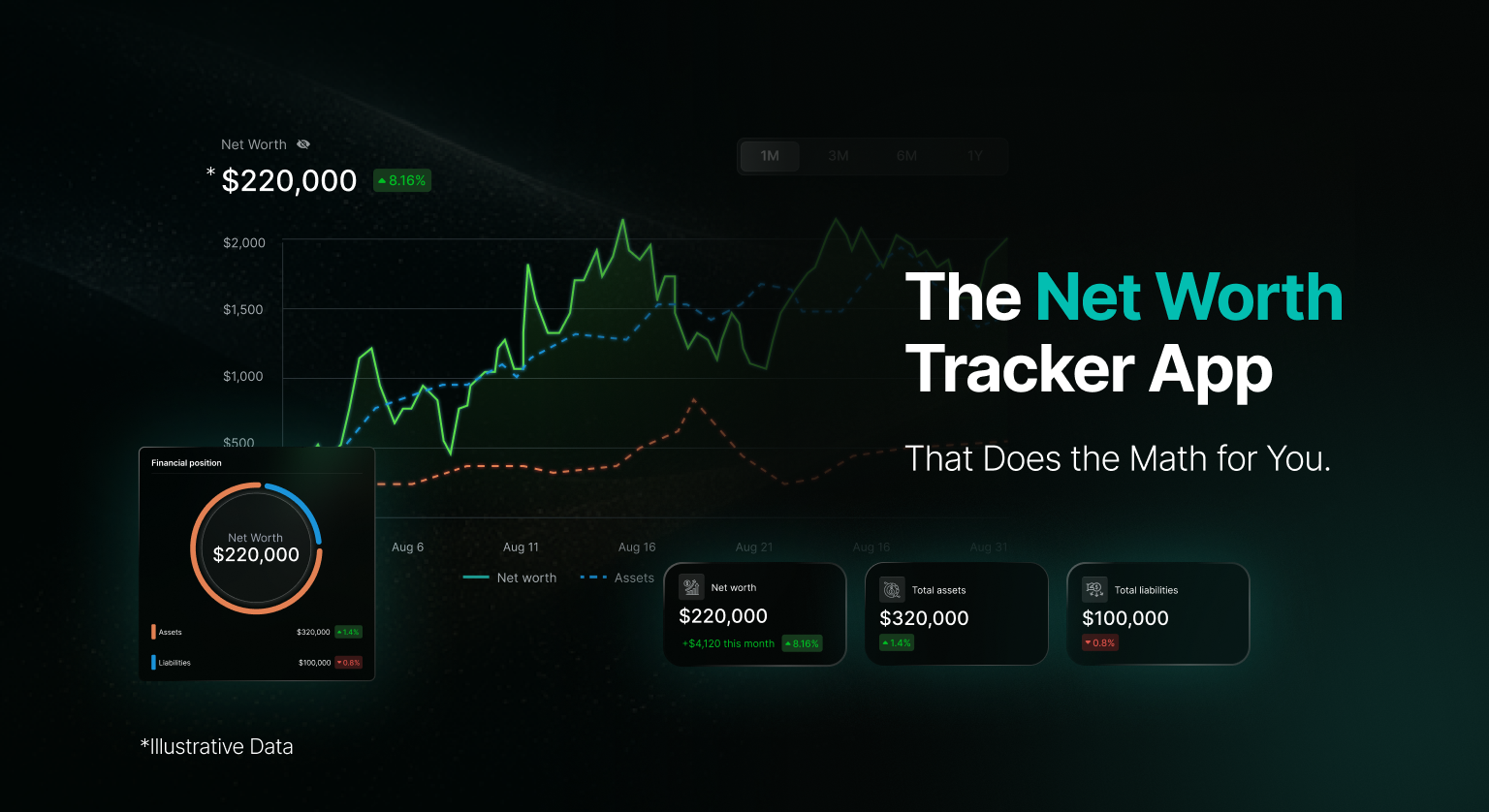
A financial assistant that only knows about your bank account has an incomplete picture of your financial life. One that knows about your bank, brokerage, retirement accounts, and crypto holdings can answer questions about your overall situation — net worth, allocation across account types, how your assets have moved over time.
The practical value: being able to ask “what is my total net worth right now, across everything?” and get an accurate answer without opening four different apps.
Surface what you are paying for without knowing it
Subscription and recurring charge tracking is one of the most consistently useful things AI financial assistants do. Not because the concept is new — but because an AI layer can identify charges that rule-based systems miss: a trial that converted to a paid plan, a price increase on an existing subscription, a recurring charge that is not obviously labeled.
Help you understand financial information in plain language
Markets moved. Your portfolio allocation shifted. An unfamiliar charge appeared. An AI financial assistant can answer the category-level version of those questions instantly, in plain English, based on your specific context. What it cannot do is give you personalised financial advice — that distinction is covered below.
What an AI Financial Assistant Cannot Do
Being clear about the limits is as important as describing the capabilities.
• It cannot predict what markets will do. Any tool that implies otherwise should be treated with caution.
• It cannot make financial decisions for you. The decisions remain yours — legally, practically, and ethically.
• It cannot replace a qualified financial advisor. A financial advisor provides personalised guidance based on your full situation and legal context.
• It cannot be more accurate than its data sources. Broken connections, mislabelled transactions, or delayed data feeds will affect the quality of answers.
• It cannot guarantee privacy or security on its own. Security depends on how the tool is built and what data practices the company follows.
The Difference Between an AI Assistant and a Chatbot
A chatbot is a question-answering tool that works from a fixed knowledge base. Ask it how to set a savings goal and it will walk you through the general process. Ask it what your spending looked like last month and it will either guess or admit it does not know.
An AI financial assistant is connected to your actual financial data. The response to “how much did I spend on dining last month?” is based on your transactions, not a general description of how dining categories work.
AI Financial Assistant for Android
How a Good AI Financial Assistant Handles Crypto
Crypto adds complexity that traditional finance tools were not designed for. A swap, a staking reward, a bridge transaction, and an airdrop all hit a wallet in ways that require context to interpret correctly. An AI assistant that understands crypto can categorise those correctly, calculate real cost basis after fees, and give you an accurate picture of your holdings across exchanges and wallets.
One that was built for traditional accounts and added crypto later often struggles here — showing you a price without knowing your actual position, or missing wallet activity entirely.
If your financial life includes meaningful crypto holdings, the questions to ask before committing to a tool: Does it connect to your actual wallet addresses? Does it handle multi-chain activity? Does it calculate cost basis accounting for gas fees?
What the First Few Weeks of Using One Actually Look Like
Week one is mostly about connecting accounts and watching the tool build a picture of your financial situation. Some connections will be smooth. Others will require troubleshooting. Expect to correct a few transaction categories that got auto-assigned wrong.
Weeks two and three are when useful patterns start to emerge. The AI has enough transaction history to surface observations you would not have made on your own.
By the end of the first month, you have a reasonable sense of whether the tool is earning its place. The clearest signal that it is: you find yourself opening it to answer a real question, rather than opening it out of obligation.
Side-by-Side: What Different Levels of AI Financial Tool Deliver
| Tool Type | What It Does | What It Does Not Do |
| Basic budgeting app | Tracks spending by category | Understand investments or crypto |
| Portfolio dashboard | Shows account values and allocation | Explain changes or answer questions |
| AI chatbot in a finance app | Answers general finance questions | Respond based on your actual accounts |
| AI financial assistant (connected) | Answers questions from your real data across all account types | Provide personalised advice or predict market movements |
Questions That Separate Useful AI Financial Tools From Marketing
Before committing to any AI financial assistant, these questions are worth asking:
• Is it answering based on my data, or generating generic responses? Test this immediately with a specific question about your accounts.
• What accounts can it actually connect? Bank, brokerage, crypto, retirement — or only some of those?
• How does it handle crypto? Specifically: wallets, multi-chain, cost basis, DeFi activity.
• What is the security model? Read-only access through a reputable connection service is the minimum standard.
• Does it sell my data? The privacy policy should be explicit on this point.
• What does it cost, and what does the free tier actually include?
The Honest Summary
An AI financial assistant is genuinely useful for people whose financial life is complicated enough that a single spreadsheet or a single app does not cover it. If your money lives across multiple account types — bank, brokerage, crypto, retirement — and you find yourself manually piecing together a picture of your overall situation, a good AI assistant can do that work for you automatically and let you ask questions about what it finds.
The AI layer is at its best when it is doing the thing AI is actually good at: processing large amounts of data, identifying patterns, and producing plain-language explanations. It is at its worst when it is used to dress up a basic dashboard with a chat interface that does not actually know anything about you.
Connect what you actually own, ask a real question, and see whether the answer is accurate. That five-minute test will tell you more than any comparison article, including this one.
Frequently Asked Questions
What does an AI financial assistant actually do?
An AI financial assistant connects to your financial accounts and lets you ask questions about your money in plain language. It can identify spending patterns, explain changes in your account values, surface recurring charges, and give you a consolidated view of your net worth. It organises and explains financial information; it does not make decisions on your behalf.
Is an AI financial assistant safe to use?
Safety depends on how the tool is built. Reputable AI financial assistants use read-only connections through secure services, which means they can see your data but cannot move your money or execute transactions. Always check the connection method and review the privacy policy before linking any accounts.
Can an AI financial assistant replace a financial advisor?
No. An AI financial assistant can organise your financial data, answer informational questions, and surface patterns. A qualified financial advisor provides personalised advice based on your goals, full financial situation, and legal context. For significant financial decisions, a human professional is not replaceable by a tool.
What is the difference between an AI financial assistant and a regular budgeting app?
A budgeting app tracks spending and helps you set monthly limits. An AI financial assistant is broader — it covers investments, crypto, and net worth alongside spending, and it responds to questions rather than displaying static charts. The AI layer means you can ask “why did my net worth change this month?” and get a contextual answer based on your actual data.
Do AI financial assistants work with crypto?
Some do, some do not — and quality varies significantly. Tools that handle crypto well connect to exchange APIs and wallet addresses, track cost basis accounting for gas fees, and handle multi-chain activity. If crypto is a meaningful part of your holdings, test this specifically before committing.
How much does an AI financial assistant cost?
Prices range from free (often with limitations or data monetisation) to approximately £10–25 per month for full-featured paid versions. Most serious tools offer a free trial of at least seven days — long enough to connect your real accounts and evaluate whether the AI responses are genuinely based on your data.
Disclaimer
This article is for general informational and educational purposes only. It does not constitute financial advice, investment advice, tax advice, or any form of personalised financial guidance.
AI financial assistants are organisational and analytical tools designed to help users understand and organise their financial information. They do not manage assets, execute transactions, or provide personalised financial recommendations. All financial and investment decisions remain solely the responsibility of the individual.
Third-party tools and services referenced or implied in this article are subject to change. Always review current product details, terms, and privacy policies directly with the relevant provider before use. For advice tailored to your personal financial situation, consult a licensed financial advisor or qualified professional in your jurisdiction.