
Quick Answer
Envelope budgeting is a spending method where you divide your income into labelled categories at the start of each month and spend only what is in each category. Traditionally done with physical cash and paper envelopes, the same principle now works digitally through apps and connected account tracking. The core idea is that pre-allocating money to categories before spending it can help limit overspending in any one area by making limits visible and concrete.
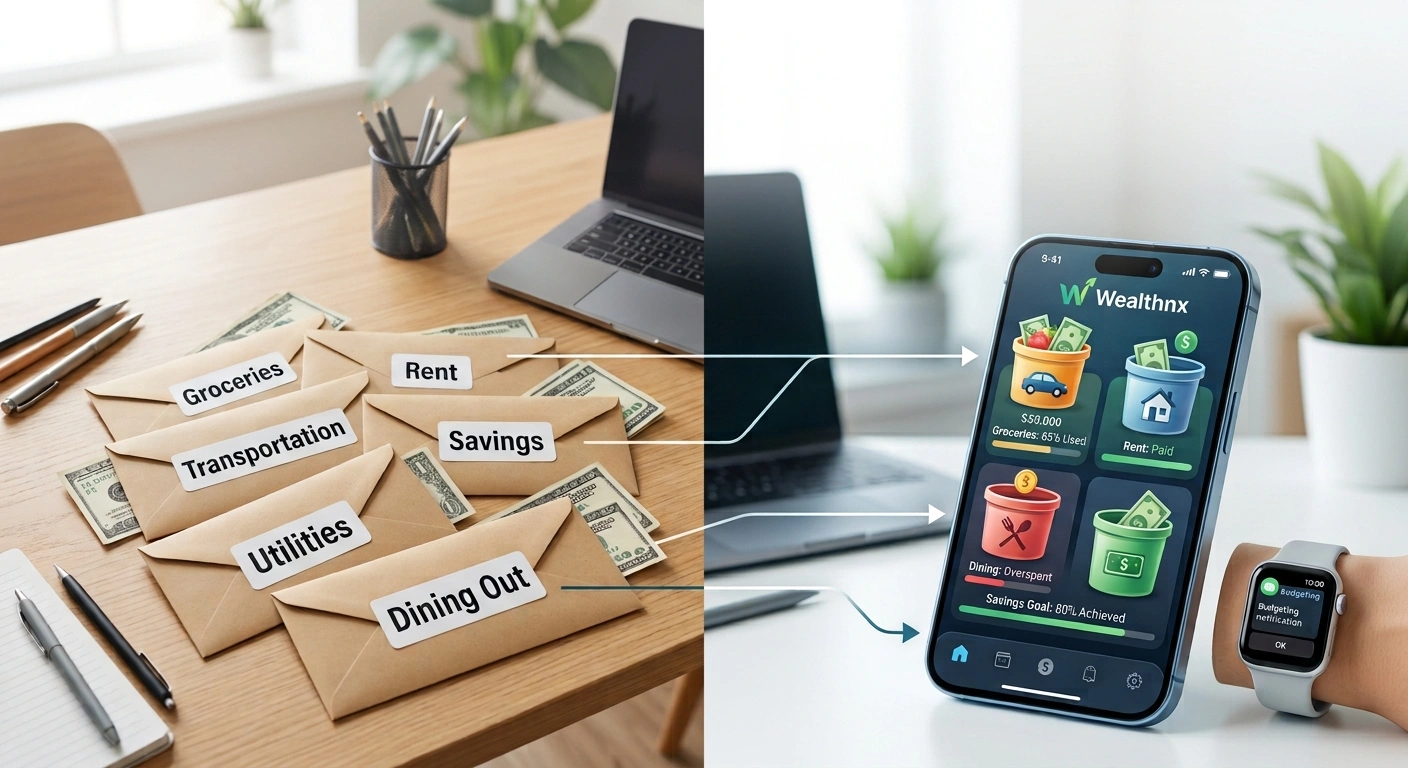
The envelope budgeting method has been around for long enough that the original version involves literal envelopes. You take your cash after payday, split it into labelled envelopes for groceries, fuel, dining out, entertainment, and so on, and you spend only what is in each envelope for the month. When an envelope is empty, that category is done until the following month.
It sounds simple because it is. That is part of why it works. According to the FINRA Foundation’s 2024 National Financial Capability Study, released in 2025, 26 percent of Americans report spending more than they earn, up from a prior range of 18 to 20 percent in earlier waves of the study. A Clever Real Estate survey of spending habits found that 39 percent of Americans exceed their budget every single month. The envelope method addresses both of those patterns at the structural level by making the cost of overspending in a category more visible rather than relying on willpower and memory alone.
The question in 2026 is whether a method built around physical cash still makes sense in a world where, according to Capital One Shopping data, an estimated 55.7 percent of American consumers use no cash in a typical week. The answer is yes, with an update.
Why the Envelope Method Works: The Psychology Behind It
The envelope method is not just an organisational system. There is genuine behavioural research behind why it can work better than a spreadsheet or a mental note for many people.
A body of research on what behavioural economists call the pain of paying has consistently found that physically handling cash tends to create a stronger psychological response to spending than a card swipe, because the loss of money can feel more immediate and visible in that moment. The envelope method uses that friction deliberately. When you can see how much remains in a category and watch the amount decrease, the cost of spending in that category is more present than an abstract card transaction that appears in a report at the end of the month.
That visibility is the mechanism that can help limit overspending. It does not guarantee it, since behaviour depends on the individual, but making limits concrete and visible removes one of the most common causes of budget failure: spending without realising how much has already gone out in a category.
The envelope method works not because it is clever accounting but because it changes how spending feels in the moment. The category is visible, the limit is concrete, and the decision to exceed it requires a conscious choice rather than a silent swipe.
How to Set Up an Envelope Budget: Step by Step
Step 1: Calculate your monthly take-home income
Start with your actual take-home pay, not your gross salary. The money you actually receive each month is the only figure that is useful for budgeting, since taxes and deductions are already gone before you see it.
Step 2: List your fixed expenses first
Write down every expense that is the same amount every month: rent or mortgage, car payment, phone bill, insurance, subscriptions with fixed prices. These are not going in envelopes since they do not vary. Subtract the total from your take-home pay. What remains is what you have available for variable spending categories.
Step 3: Decide on your variable categories
Common envelope categories include groceries, dining out, fuel, entertainment, clothing, personal care, and a miscellaneous buffer. Five to seven categories is a practical starting point. More than that tends to create more complexity than clarity, particularly in the first month or two.
Step 4: Allocate an amount to each category
Look at three months of past spending in each category to set realistic amounts rather than aspirational ones. A grocery envelope set at 200 dollars when you consistently spend 380 dollars will break down in the first week. Starting with reality and adjusting from there works better than starting with hope.
Step 5: Fund the envelopes and spend only what is in them
In the traditional version you withdraw cash and physically divide it. In a digital version you use an app or a dedicated account structure to enforce the same limits. Either way, the rule is identical: when a category is empty, spending in that category stops until the following month.
Step 6: Review and adjust at the end of the month
Which envelopes ran out early? Which ones consistently have money left over? The monthly review is where the budget improves. A category that runs empty in week two every month needs more allocated to it, a different limit, or a deliberate decision to spend less there.
Physical Envelopes vs Digital Envelope Budgeting
The original method requires cash, which creates a practical challenge in 2026. Online payments, direct debits, and card payments cover the majority of everyday spending for most people, and withdrawing cash specifically to put it in envelopes adds friction that the method does not actually require.
| Approach | How it works | Works well for | Limitation |
| Physical cash envelopes | Withdraw cash after payday, divide into labelled envelopes, spend only the cash | People who respond strongly to physical money, markets and cash-only environments | Does not work for online payments, direct debits, or card-only merchants |
| Digital envelope apps | Apps like Goodbudget, YNAB, or EveryDollar track virtual envelopes, showing how much remains in each category | People who want the structure of envelope budgeting without carrying cash | Requires manual or connected transaction tracking to keep balances accurate |
| Dedicated account structure | Separate bank accounts or sub-accounts for each category, funded at the start of the month | People who want a physical separation of funds without paper envelopes | Multiple accounts can be cumbersome to manage across a full budget |
| Connected AI finance tools | App connects to existing accounts, retrieves available transaction data, and surfaces spending observations by category | People who want category visibility without the manual setup of a traditional envelope system | Less strict than a true envelope system since it observes rather than enforces hard limits |
The principle of the envelope method, deciding how much goes to each category before you spend, works with or without physical cash. The mechanism changes. The discipline behind it does not.
Who the Envelope Method May Be Particularly Suitable For
People trying to stop overspending in specific categories
The envelope method is particularly direct at addressing one-category overspending. If dining out or clothing consistently blows the budget, a dedicated envelope with a fixed amount makes the limit concrete in a way that a mental note or a retrospective report does not.
People building budgeting habits from scratch
According to a Penny Hoarder national budgeting survey, 56 percent of respondents did not know how much they spent last month. The envelope method solves this directly: you know exactly how much remains in each category at any point in the month because you can see it. For someone who has never tracked spending before, this visibility is the starting point.
People carrying debt who want to stop accumulating more
The envelope method can help reduce the accumulation of new discretionary debt. When there is no more money in an envelope, a card swipe to cover the difference becomes a more visible, active decision rather than a passive one. A YouGov 2025 American financial attitudes survey found that 82 percent of Americans say they find the idea of being in debt stressful. The envelope method may help address that concern by making discretionary overspending more deliberate rather than automatic.
People who find digital tracking too abstract
For some people, a number on a screen does not feel real enough to change spending behaviour. The physical experience of handing over cash, or seeing a category balance hit zero in an app, creates a more immediate psychological response than a monthly report showing the total.
Where the Envelope Method Has Limits
The envelope method is a spending control tool. It is not a net worth tracker, a savings optimiser, or a way to see your overall financial picture across multiple account types. A few specific gaps are worth knowing before committing to it as the primary financial tool.
• It does not show your overall financial position. A month of perfect envelope adherence alongside significant debt is a different situation from the same performance with no debt, and the envelope system does not capture that context.
• It does not account for irregular expenses well unless you create a specific envelope for them. A car registration fee, an annual insurance premium, or an emergency repair can break an otherwise working envelope budget if they were not planned for.
• It works at the spending level, not the wealth-building level. Savings goals, account balances across multiple institutions, and longer-term financial picture are outside what the envelope method addresses on its own.
• The strict version requires cash or close manual tracking, which adds effort. A digital version reduces that effort but also reduces the psychological friction that makes physical cash effective.
How an AI Finance Tool Complements Envelope Budgeting
The envelope method and an AI finance tool address different parts of a financial picture, which means they can work alongside each other rather than replacing one another. The envelope method controls where spending goes within the month. An AI finance tool like WealthNX provides the broader connected view: what your accounts hold, how your net worth is moving over time, and informational observations about patterns across your full financial picture.
WealthNX can connect to supported bank and credit card accounts through read only connections and retrieves available transaction data from supported connected accounts, surfacing informational observations about spending by category based on available data from your connected accounts. Where the feature is available, financial information can also be added manually. All observations are informational only and should not be interpreted as financial advice. This gives a view that can complement a manual envelope system: the envelopes guide forward allocation, while the connected tool surfaces informational observations about spending patterns across supported accounts from available data. WealthNX holds ISO 27001 certification, the internationally recognized standard for information security management. WealthNX is the publisher of this article and references its own services where relevant.
The Honest Takeaway
Envelope budgeting is a behaviorally grounded method for controlling spending that has worked for decades and continues to work in 2026, with a digital update for a cashless world. The core principle, decide how much goes to each category before you spend rather than tracking what you spent after the fact, is the same whether you are using paper envelopes or a connected app.
It is not the right tool for every situation. It works at the spending level and does not address broader financial visibility across supported accounts, savings structure, or account consolidation. For someone whose primary challenge is overspending in specific categories or who has never built a consistent budgeting habit, it is one of the more direct and accessible methods available. A connected AI finance tool can provide broader financial visibility across supported accounts alongside it, offering informational observations from available data that the envelope method on its own does not address.
Frequently Asked Questions
What is envelope budgeting?
Envelope budgeting is a spending method where you divide your monthly income into labelled categories before you spend it, traditionally by putting cash into physical envelopes. You spend only what is in each envelope for the month. When an envelope is empty, spending in that category stops until next month. The same principle now works digitally through apps and connected account tracking.
Do you have to use cash for envelope budgeting?
No. The cash version creates stronger psychological spending friction, which can be useful for some people, but the same category-first allocation principle works digitally. Digital envelope apps, dedicated sub-accounts, or connected finance tools that track spending by category all apply the envelope principle without requiring physical cash.
How many envelopes should I start with?
Five to seven categories is a practical starting range for the first month or two. Starting with too many categories creates complexity that makes the system harder to maintain. Common starting categories include groceries, dining out, fuel, entertainment, clothing, and a miscellaneous buffer. More categories can be added once the habit is established.
Is envelope budgeting the same as zero-based budgeting?
They are closely related. Zero-based budgeting means assigning every dollar of income to a category so that income minus all allocations equals zero. The envelope method is essentially a zero-based budget executed through category containers, whether physical or digital. Both require allocating money before spending rather than tracking after the fact.
Does envelope budgeting work for people who spend primarily on cards?
Yes, with a digital adaptation. Physical cash envelopes are less practical for card-first spending, but digital envelope apps track the same category limits against card transactions. The psychological friction of physical cash is not present in the digital version, but the structure and visibility of category limits still provides a useful spending framework.
Sources
• FINRA Foundation, 2024 National Financial Capability Study, released July 2025, finra.org.
• Clever Real Estate, American Spending Habits 2024 Data.
• Capital One Shopping, cashless transaction statistics, 2026.
• YouGov, 2025 American Financial Attitudes Survey.
• The Penny Hoarder, national budgeting survey of 1,900 Americans.
Disclaimer
This article is for general informational and educational purposes only and does not constitute financial advice. Statistics cited are drawn from publicly available third party surveys and studies as noted in the Sources section. WealthNX is the publisher of this article and references its own services where relevant. WealthNX holds ISO 27001 certification, the internationally recognized standard for information security management.
All AI-generated observations provided by WealthNX are informational only and are not personalised financial advice. Responses are generated from available data from connected accounts and may be affected by incomplete, delayed, or unavailable data from connected accounts. For advice tailored to your situation, consult a licensed financial advisor.