
Three in four Americans cannot estimate their own net worth without checking an app first. A good tracker changes that by connecting your accounts automatically and showing the number honestly, including what you owe, not just what you own.
A recent survey from Western & Southern Financial Group found that three in four Americans cannot estimate their own net worth without opening an app or checking an account first, and one in four have never calculated it even once. Only 23 percent said they track it regularly, compared with 52 percent who keep an emergency fund and 51 percent who follow some kind of budget. People seem to know what is in their checking account. Far fewer know what they are actually worth once everything owed is subtracted from everything owned.
That gap is not really about laziness. Net worth is a strange number to calculate by hand, since it means pulling figures from a bank account, a retirement plan, maybe a brokerage account, maybe a crypto wallet, then subtracting whatever is owed on a mortgage, a car, or a credit card, all before you get one final figure. A net worth tracker app exists specifically to do that pulling and subtracting automatically. The trouble beginners run into is that the app store is full of options, and most of the marketing sounds identical.
This guide is meant to cut through that sameness and give you a short, practical list of things that actually separate a genuinely useful net worth tracker from one that just looks impressive in a screenshot.
Why Bother Tracking It at All
Net worth is the closest thing personal finance has to a single scoreboard number. According to the Federal Reserve’s Survey of Consumer Finances, the median American household net worth was 192,900 dollars in 2022, up 37 percent from 2019, the largest three year jump the survey has recorded in more than four decades of tracking. Knowing where your own number sits, and more importantly whether it is moving up or down over time, tends to matter far more than the number itself on any single day.
A separate 2025 Charles Schwab survey found that Americans on average think it takes 839,000 dollars to feel financially comfortable, a figure that varies enormously by generation and location, with Gen Z respondents setting the bar closer to 329,000 dollars and Baby Boomers closer to 943,000 dollars. Chasing someone else’s benchmark rarely helps, since the number that matters most is your own starting point compared with your own progress. Watching your own figure move in the right direction, even slowly, tends to be a far steadier source of motivation than comparing yourself to a national average that was never really built with your situation in mind.
What to Actually Look For
Full account coverage, not just a bank balance
A net worth figure that only includes a checking account is not really a net worth figure, it is a bank balance with a fancier name. Look for an app that connects to checking and savings accounts, retirement accounts, brokerage accounts, and if it applies to you, crypto exchanges and wallets. Anything left unconnected is a gap in the picture, not a rounding error.
Liabilities included, not just assets
Net worth is assets minus liabilities. An app that proudly shows a growing number while ignoring a mortgage, a car loan, or credit card balances is showing you half the math. Check specifically whether the app supports connecting loans and credit cards, not only savings and investment accounts.
Read only access, confirmed clearly
A trustworthy net worth tracker connects to your accounts through a secure, read only method, meaning it can see your balances but cannot move your money. This is usually handled through a service like Plaid for bank accounts, and through view only API keys for any crypto exchange connections. If an app ever asks for your actual banking password directly, that is a clear signal to stop.
A trend over time, not just a snapshot
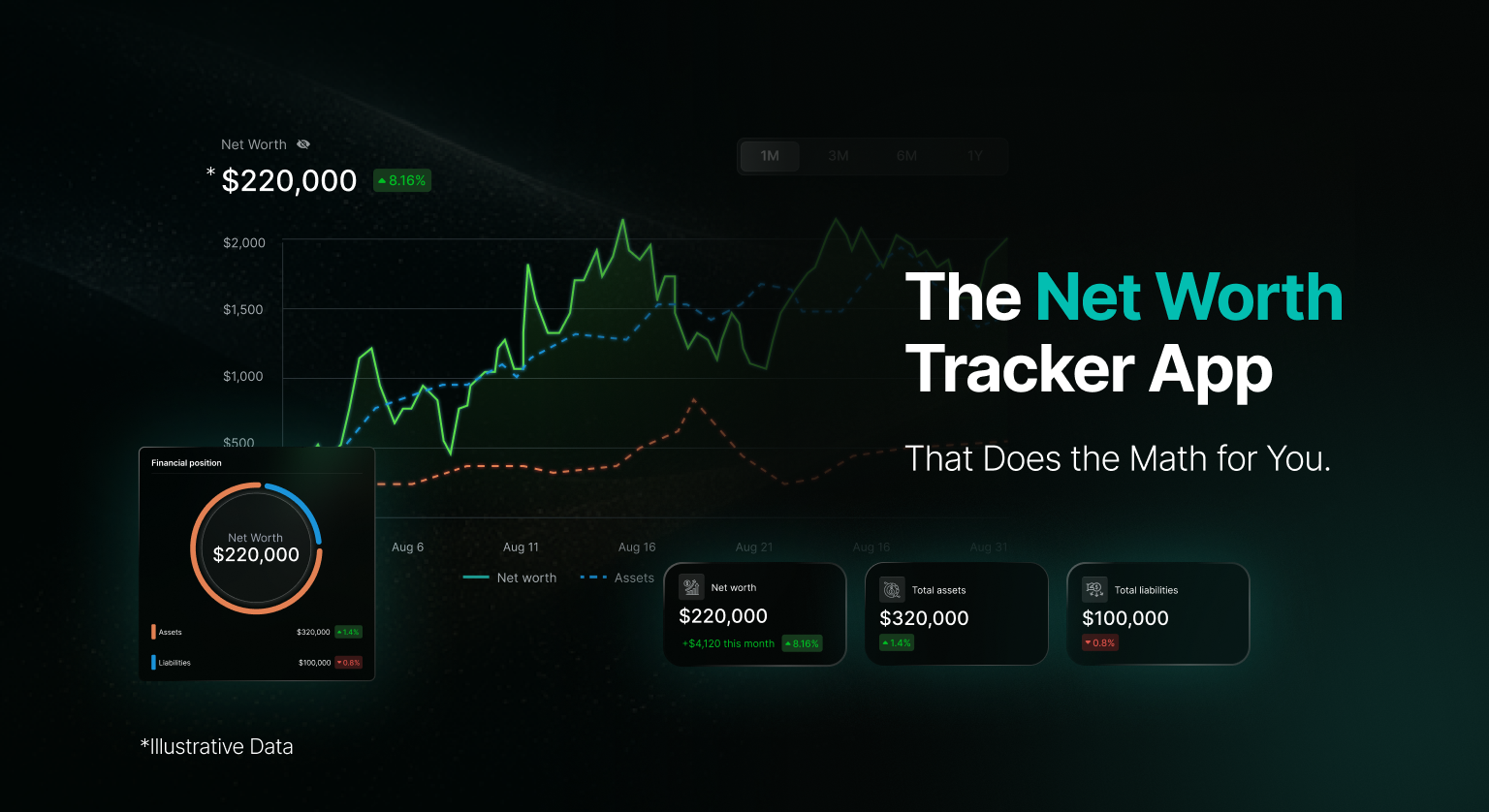
A single number on a given day tells you very little. A beginner friendly app should show how that number has moved over the past several months, since the direction matters more than any one data point. A dip after a big purchase is not the same story as a steady decline over a year, and only a trend view makes that difference visible.
Plain language, not financial jargon
Given how many people have never calculated their net worth before, the app itself should not require a finance background to use. Clear labels, simple breakdowns by account type, and observations written in ordinary language matter more for a beginner than a dense dashboard full of ratios and technical terms.
A free tier worth actually testing
A limited free version that lets you connect a few real accounts and see genuine results is far more useful for a beginner than a flashy demo screen. Before paying for anything, connect real accounts and see whether the app tells you something true and useful about your own numbers.
A Quick Comparison Checklist
| What to check | Why it matters for a beginner |
| Connects bank, investment, and crypto accounts | Leaving any category out understates your real position |
| Includes loans and credit cards | Net worth without liabilities is not a real net worth figure |
| Read only access, confirmed in the privacy policy | Protects you even if the app itself were ever compromised |
| Shows a trend over months, not just today | Direction matters more than any single day’s number |
| Free trial lets you connect real accounts | You cannot evaluate a tool you are not allowed to actually use |
Where WealthNX Fits for a Beginner
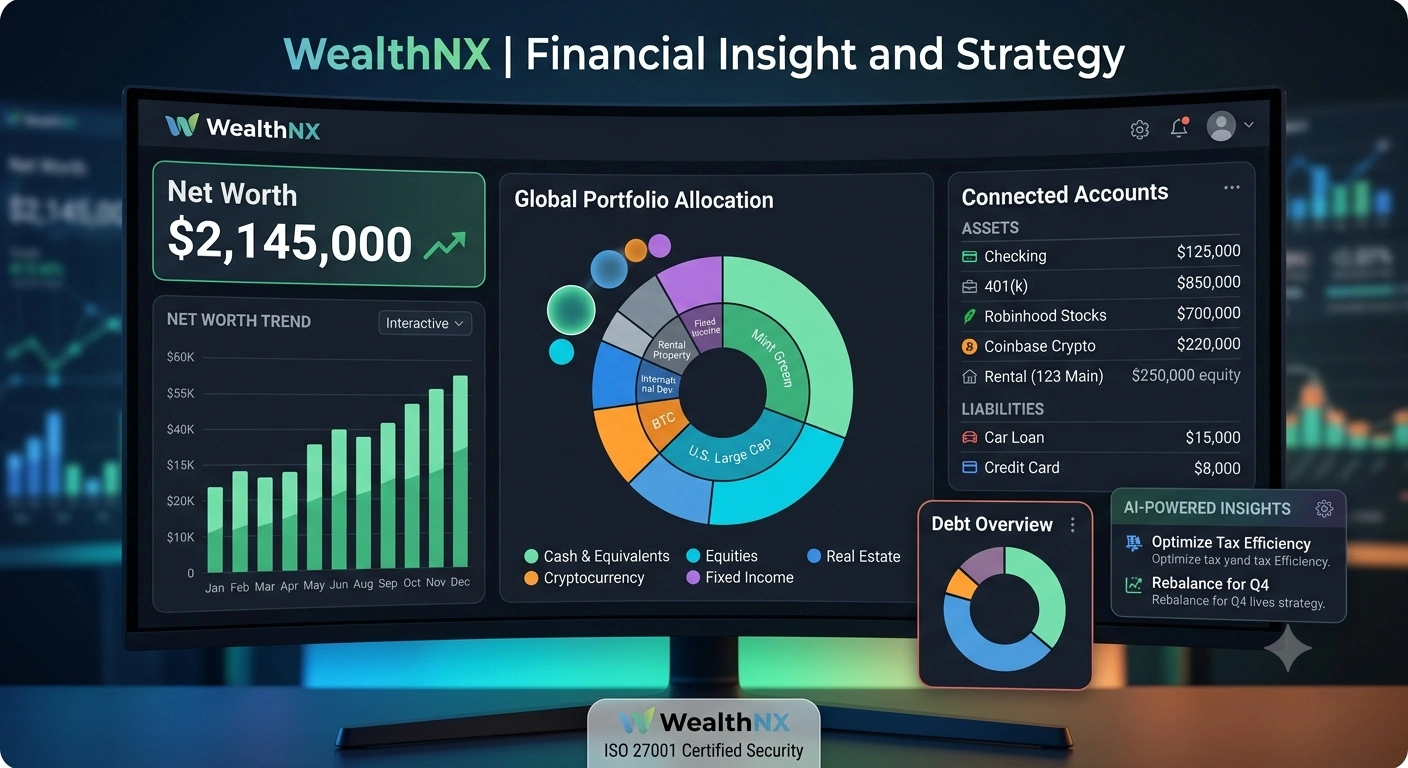
WealthNX was built with exactly this beginner gap in mind, the fact that most people have never calculated their net worth simply because pulling the numbers together by hand is tedious. It connects bank accounts, investment accounts, and crypto exchanges and wallets through read only access, combines everything including debts into a single connected net worth figure, and shows how that figure has moved over time in plain language.
WealthNX holds ISO 27001 certification, the internationally recognized standard for information security management, and its privacy policy states plainly that financial data is not sold to third parties. As the publisher of this blog, WealthNX is named here openly as a recommendation rather than presented as an independent review, and the same advice applies here as with any other app: connect real accounts and judge the results for yourself before committing to anything.
For a beginner, the best net worth tracker is not the one with the most features. It is the one that actually gets used because checking in does not feel like homework.
A Few Mistakes Beginners Tend to Make
Connecting only the accounts that feel important, like a main checking account, while skipping smaller savings accounts or an old 401k from a previous job, is one of the most common gaps. Every unconnected account is a piece of the real number missing, even if it feels minor on its own.
Checking the number too often is another common trap, especially for anyone with investments or crypto in the mix. Daily swings in a stock portfolio or a crypto price can make a perfectly healthy long term trend feel alarming if you are staring at it every single day. A monthly glance tends to tell a much calmer and more accurate story than a daily one.
Panicking over a negative number is also worth naming directly. A negative net worth, where debts currently outweigh assets, is common for people early in their careers, especially with student loans or a recent home purchase, and it is a starting point rather than a verdict. What matters most is the direction it moves from wherever it starts.
The Honest Takeaway
Most people have genuinely never calculated their net worth, not because they do not care about their finances but because doing it by hand is tedious enough that it rarely happens. A good beginner friendly tracker removes that friction entirely, connecting the accounts, doing the subtraction, and showing the trend without requiring a spreadsheet or a finance degree. The right choice is less about picking the flashiest app and more about picking one that covers your actual accounts, shows the number honestly including what you owe, and is simple enough that you will actually open it again next month.
Frequently Asked Questions
What percentage of Americans track their net worth?
A Western & Southern Financial Group survey found that only 23 percent of Americans regularly track their net worth, while three in four could not estimate it without checking an app or account, and one in four had never calculated it at all.
How often should a beginner check their net worth?
Once a month is generally plenty. Net worth moves slowly, and checking too frequently, especially if crypto or investments are involved, can make normal short term fluctuation feel more alarming than it actually is.
Do I need to include my crypto holdings in a net worth tracker?
If you hold any cryptocurrency, yes, since leaving it out understates your actual position. Look for an app that supports read only exchange connections and public wallet address tracking rather than requiring you to guess at the value manually.
Is it safe to connect my bank account to a net worth tracker app?
It is, provided the app uses read only access through a service like Plaid, meaning it can see your balances but cannot move your money. Confirm this directly in the app’s security or privacy documentation before connecting any account.
Sources
• Western & Southern Financial Group survey, reported via InvestmentNews, 2026.
• Federal Reserve, Survey of Consumer Finances, 2022 data, released 2023.
• Charles Schwab, 2025 Modern Wealth Survey.
Disclaimer
This article is for general informational and educational purposes only and does not constitute financial advice. Statistics cited are drawn from publicly available third party surveys as noted in the Sources section. WealthNX is the publisher of this blog and is named here as a recommended app; this recommendation is disclosed openly and is not an independent review. WealthNX holds ISO 27001 certification, the internationally recognized standard for information security management.
All AI generated observations from finance apps are informational only and are not personalised financial advice. Responses are generated from connected account data and may be affected by incomplete or delayed information. Cryptocurrencies are highly volatile. For advice tailored to your situation, consult a licensed financial advisor.