

Most people have a rough sense of what they own. The number in their checking account. The approximate value of their pension or 401(k). The crypto portfolio they check too often. But ask anyone for their actual net worth — a precise figure that adds everything up, subtracts what they owe, and gives a single number that reflects their actual financial position — and the answer is usually a hesitant estimate.
That gap exists because real financial lives are distributed. A bank account here, a stocks and shares account there, a crypto wallet, a workplace pension, a mortgage, a car loan. None of those speak to each other. Pulling them together manually takes time, discipline, and the kind of patience most people do not have consistently.
AI financial assistants are built to close that gap automatically. This piece walks through exactly how to use one to build and maintain a connected picture of your net worth across every account type — what to connect, how the tracking works, what to look for, and where the limits are.
What Net Worth Actually Means in This Context
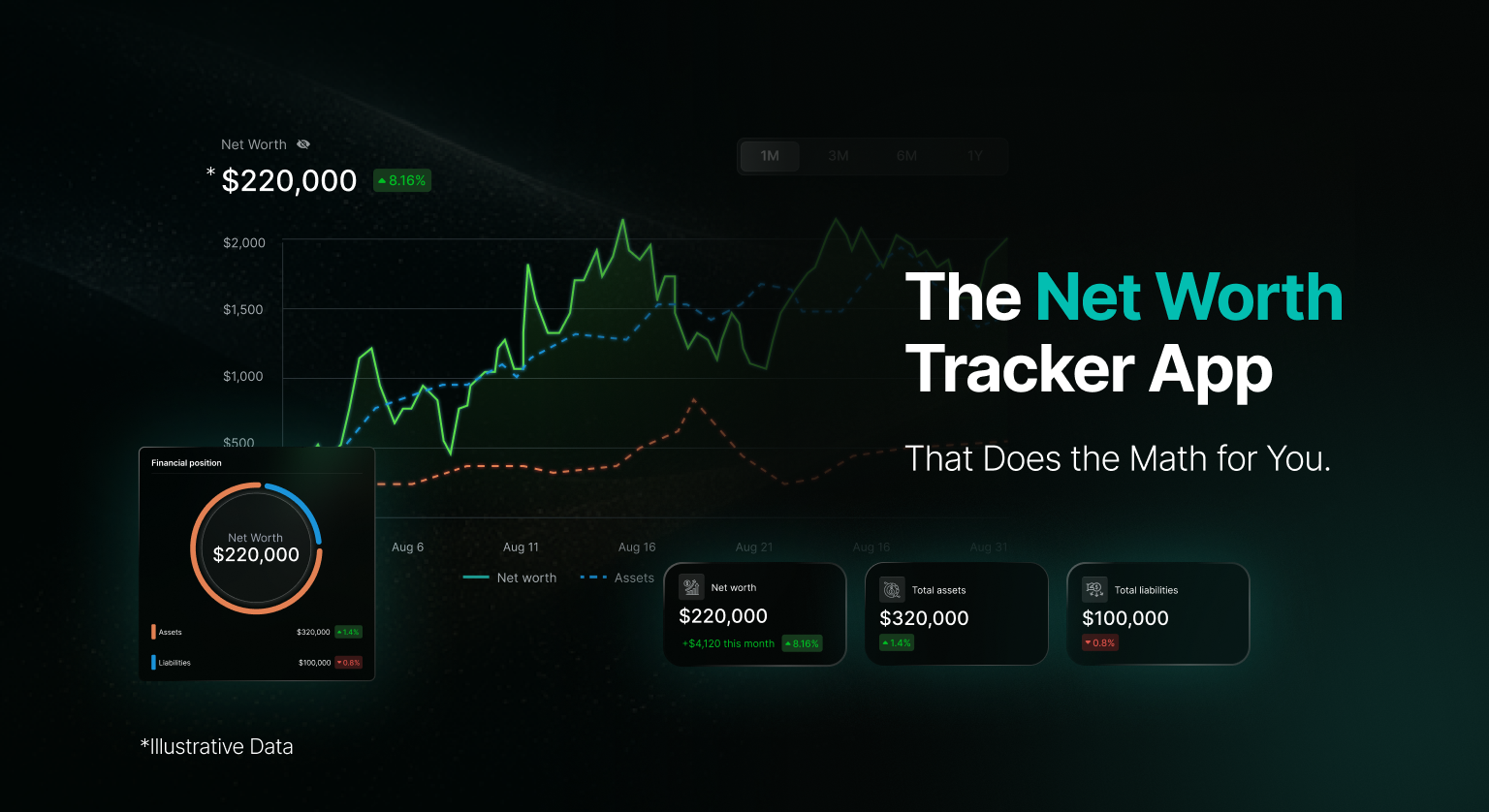
Net worth is the simplest number in personal finance: everything you own minus everything you owe. Assets minus liabilities.
| Assets (what you own) | Liabilities (what you owe) |
| Cash in current and savings accounts | Mortgage balance |
| Stocks, funds, ETFs in brokerage accounts | Personal loans |
| Pension and retirement account values | Credit card balances |
| Crypto holdings across exchanges and wallets | Car finance or leasing agreements |
| Property equity (current value minus mortgage) | Student loans |
| Other investments (bonds, ISAs, etc.) | Any other outstanding debts |
The number that matters is the difference between those two columns. A high income with high liabilities can produce a low or negative net worth. A modest income with growing assets and low debt can produce a strong one. Tracking it accurately over time is one of the most useful things you can do to understand your financial position.
The challenge is not knowing what net worth means. The challenge is actually calculating it, consistently, across all the places your money lives — and keeping that calculation current without it becoming a full-time job.
Why Tracking Net Worth Manually Always Falls Apart
The spreadsheet approach to net worth tracking works well for about three weeks. Then life happens.
A crypto price moves and the figure is immediately out of date. You forget to update the mortgage balance after a monthly payment. The pension value changes and you do not have the login details to hand. One account gets missed. The spreadsheet becomes a historical document rather than a live number.
The specific failure modes are predictable:
• Manual entry creates gaps. Numbers only update when you remember to update them, which means the figure is almost always at least slightly wrong.
• Multiple logins create friction. Most people have accounts across four or more institutions. Logging into each one to pull a current figure takes time that most people will not consistently spend.
• Crypto is genuinely hard to track manually. Exchange balances, wallet holdings, and staking rewards do not fit neatly into a spreadsheet cell, and prices move too fast for manual entries to stay current.
• Debt tracking gets neglected. Assets are easy to feel good about. The liability column tends to get updated less frequently, producing a net worth figure that flatters the reality.
• Without consistent historical tracking, there is no trend to see. Whether net worth is growing, shrinking, or staying flat only becomes visible if the tracking is consistent over time.
An AI financial assistant solves these problems by automating the data gathering from your connected accounts. You connect your accounts once. The assistant handles the updates.
What to Connect: A Full Account Checklist
The accuracy of your connected net worth figure is directly proportional to how completely you have set up your account connections. A partial connection produces a partial picture. Here is a complete breakdown of what to link and why each category matters.
Bank accounts (current and savings)
These are usually the easiest connections and the foundation of any net worth calculation. Link every account where cash sits: checking accounts, savings accounts, high-yield savings, fixed-term deposits. Connection is typically via a secure read-only banking data service — meaning the tool can see balances and transactions but cannot move money.
Investment and brokerage accounts
Stocks, funds, ETFs, and general investment accounts. These fluctuate as market prices change, which is precisely why automated tracking from connected accounts is more useful than a monthly manual update. The connected view gives you a latest-available valuation without requiring you to log in to each brokerage.
Pension and retirement accounts
Workplace pensions, 401(k)s, IRAs, SIPPs, and any other retirement accounts should be included for an accurate long-term picture. Some platforms connect directly; others require a manual balance entry that the assistant stores and you update periodically. Either way, leaving pensions out significantly understates your actual position.
Crypto exchanges and wallets
For exchange holdings: connect via a read-only API key — a key that lets the tool see your balances but cannot trade or withdraw on your behalf. For wallet holdings: connect via your public wallet address, which lets the tool monitor on-chain balances without needing any credentials. Never share your private key or seed phrase with any tool.
If you have DeFi positions, staking rewards, or holdings across multiple chains, check specifically that the tool supports those before connecting. Coverage varies between platforms.
Property
Property value is the one major asset that cannot be connected to a live data feed in most tools. Most AI financial assistants handle this as a manual entry — you input the current estimated value and update it when you have a better figure. The mortgage balance, by contrast, can often be connected directly to your lender.
Liabilities: loans, credit cards, mortgages
Net worth without liabilities is just a gross assets figure. Connect your mortgage, any personal loans, credit card accounts, and car finance to get a connected picture that reflects your actual financial position. Without the liability side, any net worth figure the tool produces is flattering and incomplete.
| Account type | Connection method | Update frequency |
| Bank accounts | Read-only banking service (e.g. Plaid) | Daily or on transaction |
| Investment accounts | Broker connection or banking service | Daily or market close |
| Pension accounts | Platform connection or manual entry | Monthly or on update |
| Crypto (exchange) | Read-only API key | Latest available from exchange |
| Crypto (wallet) | Public wallet address (on-chain) | On-chain as transactions occur |
| Property | Manual entry | On your update |
| Mortgage | Lender connection or manual entry | Monthly |
| Credit cards / loans | Banking service or manual entry | Daily or on update |
Step-by-Step: Setting Up Net Worth Tracking With an AI Assistant
Here is the practical sequence for getting your connected net worth tracking set up properly from scratch.
Step 1 Connect your bank accounts first
Start with your checking and savings accounts. These are the most straightforward connections and give the AI assistant a foundation of real cash data. Most tools walk you through this with a guided bank selection flow. You will be redirected to your bank to authorise read-only access, then returned to the app with the connection live. Your banking credentials are entered with the bank or a trusted intermediary service, not with the AI app itself.
Step 2 Add investment and brokerage accounts
Connect any ISAs, 401(k)s, IRAs, SIPPs, or general investment accounts. Where a direct connection is available, use it. Where it is not, most tools offer a manual balance entry as a fallback. For manually entered values, note the date of the entry so you know how current the figure is.
Step 3 Set up crypto connections
For exchange holdings: go to your exchange settings, generate a read-only API key with view-only permissions (no trading, no withdrawal permissions), and enter the key in the tool. For wallet holdings: copy your public wallet address — not your private key or seed phrase, never share those — and paste it into the wallet tracking section. Verify after connecting that the balance shown matches what you see in your exchange account or wallet.
Step 4 Enter property and manual assets
Add any property you own with a current estimated value. Use a recent comparable sale from your area if you do not have a formal valuation. Add any other significant assets that cannot be connected digitally: physical assets, shares in private companies, or any other holdings the tool cannot connect to automatically.
Step 5 Add all liabilities
Connect or manually enter every debt: mortgage balance, personal loans, credit cards, car finance. This is the step most people skip or deprioritise. Leaving liabilities out produces a connected net worth figure that looks better than it is.
Step 6 Review the consolidated figure and check for gaps
Once everything is connected, look at the total net worth figure and mentally cross-check it against what you know you own. Does it feel approximately right? If a number looks significantly off, investigate that account category. Early calibration catches connection issues before you start relying on the figures.
Step 7 Set a review cadence
An AI assistant updates automatically from connected accounts, but it is worth checking in deliberately — once a month is enough for most people. This is when you update manual entries (property value, any pension that does not connect), review any connection errors, and look at the net worth trend over time.
What the AI Layer Adds Beyond a Spreadsheet
At the mechanical level, an AI financial assistant does what a well-maintained spreadsheet does: aggregates your connected account values and subtracts your liabilities. The difference is what sits on top of that aggregation.
Plain-language answers to specific questions
Instead of navigating to a dashboard and doing mental arithmetic, you can ask directly: “What is my net worth today based on my connected accounts?” or “How has my net worth changed over the past six months?” or “How much of my connected net worth is in cash versus investments?” The AI assistant produces an observation based on your connected account data, without requiring you to build or maintain a formula. These observations are informational only.
Trend observation over time
A single net worth figure is a snapshot. A series of them over months and years is a picture of financial direction. An AI assistant maintains that history automatically from connected account data, so you can observe whether your net worth has been growing, by how much, and which account categories appear to be driving the change.
Allocation visibility across account types
Knowing your net worth figure is useful. Knowing how it is split — how much is in cash, how much in investments, how much in property, how much in crypto — is more useful. The AI assistant can surface this breakdown from your connected accounts without requiring you to calculate it manually, and can flag when your allocation has shifted significantly from its previous pattern.
Connection quality monitoring
When a data feed breaks — a bank changes its API, an exchange updates its authentication, a connection lapses — an AI assistant will flag it rather than silently serving you a stale figure. That kind of data quality visibility is something a manual spreadsheet cannot provide.
Context for changes in connected data
When your net worth figure changes, the AI assistant can surface observations about which accounts and which asset categories in your connected data appear to have contributed to the movement. This is not a definitive explanation of market causation, but it gives you a more granular picture of where change occurred within your own connected holdings.
A Note on Crypto: Where Net Worth Tracking Gets Complicated
Crypto holdings are the asset type that most challenges net worth trackers, and where the gap between capable platforms and weak ones is most visible.
• Price volatility means the net worth figure based on crypto moves significantly day to day. This is real — the AI assistant is reflecting the latest available pricing data from connected exchanges and wallets, not malfunctioning. Cryptocurrencies and other digital assets are highly volatile and may experience significant price fluctuations over short periods.
• Multi-chain holdings require the tool to monitor multiple blockchains independently. If you hold assets on Ethereum, Solana, and a Layer 2 network, a tool that only reads one chain will systematically undercount your crypto net worth.
• DeFi positions — liquidity pools, yield farming, lending protocols — are not simple token balances. Accurately reflecting these positions requires the tracker to understand each protocol specifically. Coverage varies significantly between platforms.
• Staking rewards accumulate continuously and need to be included in the holding value for an accurate connected picture.
• Cost basis tracking matters for understanding the relationship between what you originally paid and what the holding is worth today based on latest available pricing, not just for tax purposes.
If crypto is a meaningful portion of your connected net worth, verify specifically that the AI assistant’s crypto tracking covers your actual holdings, chains, and any DeFi positions before relying on it for a complete net worth figure.
How to Read Your Connected Net Worth Data Once It Is Tracking
Look at the trend, not just the latest available figure
A net worth figure at one point in time tells you your position at that moment. Net worth tracked over six or twelve months from connected accounts tells you something more useful: whether you are building or eroding financial position, how fast, and what appears to be driving it. Look at the direction of travel as much as the current figure.
Watch the asset mix
If the majority of your connected net worth is in one asset type — all cash, all property, all crypto — that concentration becomes visible in the AI assistant’s view. The AI can surface this observation. What to do about it is a question for your own judgement and, for significant decisions, a professional financial advisor.
Update manual entries on a schedule
Property values and any manually entered assets do not update themselves. Build a habit of reviewing them once a quarter, or whenever you have a better figure. A stale property value is one of the most common sources of inaccuracy in connected net worth tracking.
Use the AI to answer specific questions about your connected data
Do not just check the total. Ask the questions that are actually useful to you. “How much has my net worth changed in the last three months based on my connected accounts?” “What percentage of my connected assets are in cash?” “How much do I still owe overall across connected liability accounts?” These are specific questions with answers that live in your connected account data.
Honest Limits: What Net Worth Tracking Cannot Do
• It only reflects connected accounts. Assets not connected to the tool — private business equity, unlisted shares, physical assets — require manual entry and your own judgement on value.
• AI observations are informational only. The assistant surfaces observations about your connected account data. It does not tell you what your net worth should be, whether your financial position is good or bad relative to any benchmark, or what financial decisions to make.
• It cannot predict future net worth. Any feature that implies otherwise should be treated with significant scepticism.
• It does not provide financial advice. Knowing your connected net worth accurately is useful. What to do with that information — how to allocate, how to reduce liabilities, how to plan for the future — is a decision that benefits from professional guidance.
• It is only as accurate as its connections. A broken feed, a missed account, or a stale manual entry produces an inaccurate figure. Regular review of connection quality is part of using the tool properly.
An accurate connected net worth figure based on your accounts is a foundation, not an answer. It tells you where you stand. What to do from there is a separate question, and one that warrants professional guidance for significant decisions.
The Honest Summary
Tracking net worth across all accounts is one of the most practically valuable things an AI financial assistant can do. It solves a real problem — financial life is distributed across too many platforms to track manually with any consistency — and it does so automatically once your connections are set up.
The setup takes an hour, maybe two if you have a lot of accounts or complex crypto holdings. After that, the connected figure updates itself as account data syncs. The AI surfaces observations about it. The trend becomes visible over time.
The result is not a magic number that tells you what to do. It is a connected, regularly updated picture of your financial position based on your actual accounts — something most people do not have, and something that makes every other financial conversation more grounded and more honest. All observations surfaced by the AI are informational only and should not be interpreted as financial advice.
Frequently Asked Questions
How does an AI financial assistant calculate net worth?
It connects to your financial accounts — bank, investment, crypto, pension, mortgage, loans — and aggregates the latest available values from each connected source. Assets are totalled, liabilities are subtracted, and the result is your connected net worth figure. The calculation updates as connected account data syncs, without requiring manual entry. Figures reflect the latest available data from each connection, which may not be real-time for every source.
Is it safe to connect all my accounts to one tool?
Reputable AI financial assistants use read-only connections through secure services like Plaid that authenticate with your bank without the app ever receiving your credentials. Read-only means the tool can see your balances and transactions but cannot move money. For crypto exchange connections, always use read-only API keys with view-only permissions. For wallet tracking, share your public address only — never your private key or seed phrase.
How do I connect crypto wallets without sharing my private key?
You share your public wallet address only. This lets the tool monitor on-chain balances and transaction history without any access to the wallet itself. For exchange holdings, generate a read-only API key in your exchange account settings with view-only permissions and no trading or withdrawal rights. Never share a private key or seed phrase with any tool or service.
What if my pension or property cannot be connected directly?
Most AI financial assistants support manual balance entries for accounts that do not have a direct connection. You enter the current value, the tool stores it and includes it in your connected net worth calculation, and you update it periodically as the value changes. Note the date of each manual entry so you know how current the figure is.
How often does the connected net worth figure update?
For connected accounts with live data feeds, the figure updates as new data arrives from each connection. This is not necessarily real-time for every platform — some update daily, some at market close, some when transactions occur. Manual entries only update when you change them. AI responses about your net worth reflect the latest available data from your connections at the time of the response.
Can the AI tell me if my net worth is on track?
An AI financial assistant can surface observations about what your connected net worth is and how it has changed over time based on your connected account data. It does not provide personalised financial advice or benchmarks for whether your position is appropriate for your age, income, or goals. All AI-generated observations are informational only. For that kind of assessment, a qualified financial advisor is the appropriate resource.
Disclaimer
This article is for general informational and educational purposes only. It does not constitute financial advice, investment advice, tax advice, or any form of personalised financial guidance. Nothing in this article should be interpreted as a recommendation to take any specific financial action.
AI-generated observations and net worth figures are informational only, based on connected account data, and should not be interpreted as personalised financial advice. AI responses are generated from connected account data and may be affected by incomplete, delayed, or inaccurate information from connected sources. Net worth figures reflect the latest available data from connected accounts and may not represent real-time balances at every moment.
Cryptocurrencies and other digital assets are highly volatile and may experience significant price fluctuations over short periods. The value of digital asset holdings can decrease substantially, including to zero. For advice tailored to your personal financial situation, consult a licensed financial advisor or qualified professional in your jurisdiction.