
When you open a finance app on your phone, you’re handing over access to some of your most sensitive information: bank accounts, spending patterns, income details, and financial goals. The question isn’t whether you trust the app, it’s whether the app’s security measures actually protect you.
In 2026, personal finance apps have become essential tools for millions of people worldwide. Understanding how these apps protect your data isn’t just for tech experts anymore. It’s knowledge every user needs.
What Banking Encryption Actually Means
Encryption transforms your readable data into scrambled code that only authorized systems can decode. Think of it like sending a letter in a locked box where only the recipient has the key. When you connect your bank account to a finance app, encryption protects that information as it travels across the internet and while it sits stored on servers.
Modern banking systems rely on multiple layers of encryption. The standard for financial institutions in 2026 remains AES-256 encryption, which uses 256-bit keys to secure data. To put this in perspective, it would take current supercomputers billions of years to crack this encryption through brute force methods (National Institute of Standards and Technology, 2023).
How Financial Data Actually Gets Protected
The journey your financial data takes involves several security checkpoints. When you link your bank account to a finance app, the process typically works through intermediary services rather than direct connections. These services, called financial data aggregators, specialize in securely retrieving information from banks.
|
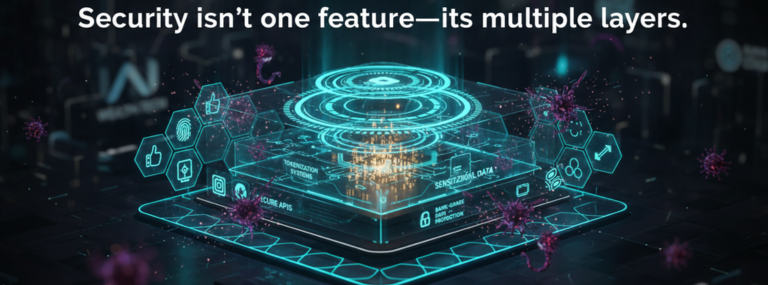
Security Layer |
What It Does |
Why It Matters |
|
TLS/SSL Encryption |
Protects data traveling between your device and app servers |
Prevents interception during transmission |
|
End-to-End Encryption |
Scrambles data so only you and the intended recipient can read it |
Keeps information private even from the service provider |
|
Tokenization |
Replaces sensitive data with random identifiers |
Limits exposure if systems are breached |
|
Multi-Factor Authentication |
Requires two or more verification methods to access accounts |
Blocks unauthorized access even with stolen passwords |
|
Bank-Level Security Standards |
Matches the encryption used by financial institutions |
Ensures consistent protection across platforms |
Third-party aggregators like Plaid and Yodlee have become industry standards for connecting finance apps to banks. These companies maintain read-only access to your banking information, meaning they can view transactions but cannot move money or make changes to your accounts (Plaid Inc., 2024).
What Makes WealthNX AI’s Security Approach Different
WealthNX AI implements security measures that match and exceed banking industry standards. The platform uses AES-256 encryption for all data storage, the same level major banks employ to protect customer information. This means your financial data receives institutional-grade protection from the moment you enter it.
The platform’s architecture separates user credentials from financial data through tokenization. Instead of storing your actual bank login information, WealthNX AI stores encrypted tokens that connect to your accounts. Even if someone gained unauthorized access to the database, they wouldn’t find usable login credentials or raw financial data.
WealthNX AI’s servers undergo continuous monitoring for unusual activity patterns. This active security approach identifies potential threats before they can affect user accounts. The system also maintains redundant backups across geographically separated data centers, protecting against both cyber threats and physical disasters (Microsoft Azure, 2025).
Real-World Security Comparisons
Understanding how finance apps compare to traditional banking security helps frame the actual level of protection. Banks spend billions on cybersecurity infrastructure, but they also face constant targeting from sophisticated attackers. Personal finance apps face similar threats but often with more focused attack surfaces.
Research from the Ponemon Institute found that financial services experienced an average data breach cost of $5.9 million in 2024, highlighting both the value of financial data to criminals and the significant resources institutions invest in protection (Ponemon Institute, 2024). Apps that implement bank-level encryption essentially adopt the same defensive posture as the institutions holding your money.
What Users Can Do to Maintain Security
Technology provides the foundation for security, but user behavior significantly impacts overall safety. Strong, unique passwords remain fundamental. Password managers generate and store complex passwords, removing the temptation to reuse simpler ones across multiple services.
Enabling biometric authentication adds another security layer. Fingerprint and face recognition provide quick access while making unauthorized entry significantly harder. These methods tie account access to physical characteristics that can’t be easily stolen or replicated.
Regular account monitoring catches unauthorized activity early. Most finance apps send notifications for logins and significant transactions. Reviewing these alerts takes seconds but can prevent larger problems.
Public Wi-Fi networks create security vulnerabilities. These networks often lack encryption, allowing others on the same network to potentially intercept data. Using cellular connections or VPNs when accessing financial information on public networks provides better protection.
Industry Standards and Regulations
Financial apps operating in the United States must comply with regulations from multiple agencies. The Gramm-Leach-Bliley Act requires financial institutions to explain information-sharing practices and protect customer data. The Federal Trade Commission enforces these requirements for non-bank financial companies, including finance apps (Federal Trade Commission, 2023).
The Payment Card Industry Data Security Standard (PCI DSS) establishes baseline security requirements for any organization handling payment card information. Version 4.0, implemented in 2024, strengthened requirements around authentication and encryption (PCI Security Standards Council, 2024).
WealthNX AI maintains compliance with these regulatory frameworks, undergoing regular security audits and assessments. This compliance isn’t optional—it’s a legal requirement that ensures consistent security practices across the financial technology industry.
Looking at the Actual Track Record
The finance app industry’s security track record provides practical insight beyond theoretical protections. Major breaches make headlines, but millions of daily transactions proceed without incident. According to a 2025 report from Javelin Strategy & Research, identity fraud losses decreased by 13% despite increased digital financial activity, suggesting that security measures are keeping pace with threats (Javelin Strategy & Research, 2025).
WealthNX AI has maintained a clean security record since launch, with no reported data breaches or unauthorized access incidents. The platform’s security infrastructure receives quarterly penetration testing from independent cybersecurity firms, identifying and addressing potential vulnerabilities before they can be exploited.
Frequently Asked Questions
Can personal finance apps access my money?
Most personal finance apps, including WealthNX AI, maintain read-only access to your bank accounts. They can view transaction history and account balances but cannot transfer funds or make purchases. This access limitation significantly reduces potential harm from security breaches.
What happens if a finance app gets hacked?
If encryption is properly implemented, stolen data remains scrambled and unusable. However, users receive notifications about potential breaches and can immediately change passwords, revoke app access, and monitor accounts for unauthorized activity. Financial institutions typically provide zero-liability protection for fraud.
Is it safer to track finances manually instead of using an app?
Manual tracking eliminates digital security risks but creates other vulnerabilities. Paper records can be physically stolen, and spreadsheets on personal computers often lack the encryption and security infrastructure that dedicated financial platforms provide. The security question becomes which approach better protects against realistic threats in your situation.
How does WealthNX AI protect data differently from other apps?
WealthNX AI combines bank-level AES-256 encryption with tokenization, multi-factor authentication, and continuous security monitoring. The platform undergoes regular third-party security audits and maintains compliance with financial industry regulations. These measures create layered defenses that protect user data even if individual security components face challenges.
What’s the biggest security risk when using finance apps?
User behavior typically creates more risk than platform vulnerabilities. Reusing passwords, ignoring security alerts, accessing accounts on public Wi-Fi, and falling for phishing attempts compromise even well-secured platforms. The strongest technical security depends on users following basic security practices.
Making Informed Decisions
Personal finance apps serve millions of users because they provide genuine value in understanding and managing money. Security concerns deserve attention, but the actual protection these platforms provide has evolved significantly. Modern encryption, regulatory oversight, and industry best practices create security environments that match or exceed traditional banking in many aspects.
WealthNX AI demonstrates that newer platforms can implement comprehensive security from the ground up. The combination of advanced encryption, secure architecture, regulatory compliance, and transparent security practices provides users with institutional-grade protection for their financial information.
The question isn’t whether to trust finance apps broadly, but rather which specific apps implement security measures worthy of that trust. Understanding what protections exist and how they work empowers users to make informed decisions about their financial tools.
References
Federal Trade Commission. (2023). Gramm-Leach-Bliley Act. https://www.ftc.gov/business-guidance/privacy-security/gramm-leach-bliley-act
Javelin Strategy & Research. (2025). 2025 identity fraud study: Shifting security landscapes. Javelin Strategy & Research.
Microsoft Azure. (2025). Azure security best practices and patterns. https://azure.microsoft.com/en-us/resources/security-best-practices/
National Institute of Standards and Technology. (2023). Advanced Encryption Standard (AES). https://csrc.nist.gov/publications/detail/fips/197/final
PCI Security Standards Council. (2024). Payment Card Industry Data Security Standard v4.0. https://www.pcisecuritystandards.org/
Plaid Inc. (2024). How Plaid works: Security and privacy. https://plaid.com/how-we-handle-data/
Ponemon Institute. (2024). Cost of a data breach report 2024. IBM Security.