
Most people hesitate for a moment before they link a bank account to a new app. That hesitation is reasonable. According to the Identity Theft Resource Center, 2025 set a record for the number of publicly reported data compromises in the United States, and in a related consumer survey the organization found that 80 percent of people had received at least one breach notification in the past year. Separately, Javelin Strategy and Research put total identity fraud losses at 27.3 billion dollars in 2025.
Those numbers are not about AI finance apps specifically. They describe how often personal data gets exposed somewhere, by someone, in an economy where almost every company holds a little piece of your information. Against that backdrop, wondering whether it is safe to connect your bank account to a finance app is a fair question, and it deserves a real answer rather than a blanket yes.
The short version is that it depends entirely on how the app is built. Some are genuinely careful about how they handle your data. Others cut corners in ways that matter, whether that is a vague privacy policy, a connection method that asks for more than it should, or marketing language about security that does not hold up when you actually look for the details. This article walks through what a well built AI finance app actually does with your data, what real risks look like versus the ones that tend to get overstated online, and what to check before you connect anything at all.
What Connecting an Account Actually Shares
A properly built AI finance app never asks for your banking username and password directly. Instead, it routes you through a service like Plaid, which handles the authentication with your bank and then hands the app a token, not your credentials. The app can see your balances and transaction history through that connection. It cannot see your password, and it cannot log into your bank account independently or on its own initiative.
For crypto, the same principle applies in a different form. Exchange balances are typically read through an API key you generate yourself, one you can restrict to view only permissions with no ability to trade or withdraw. Wallet balances are tracked through your public address, the same information anyone could already look up on a blockchain explorer, never your private key or seed phrase. If an app or a website ever asks you for either of those directly, that is a clear signal to stop and walk away, regardless of how legitimate the request sounds.
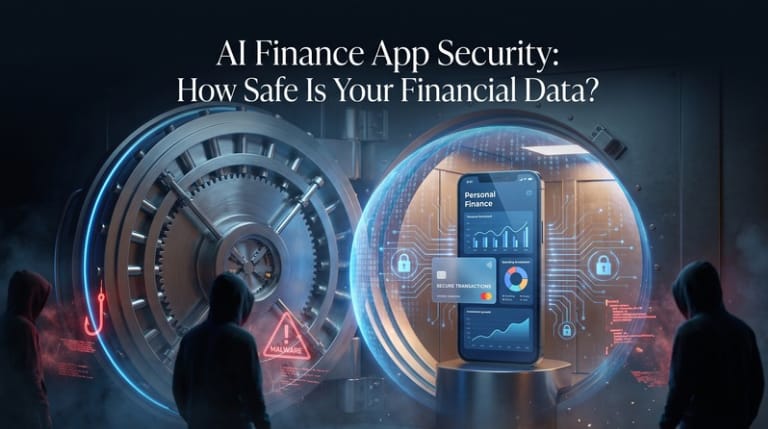
A well built AI finance app sees your financial data as a read only observer. It cannot move money, execute trades, or alter your accounts in any way.
The Real Risk Versus the One People Worry About Most
The fear most people describe is some version of the app draining their account. With a properly configured read only connection, that specific fear does not hold up well under scrutiny. A read only token has no mechanical ability to initiate a transfer, even in a worst case scenario where the app itself is compromised. What a breach at the app level could expose instead is information, balances and transaction history, which is a real concern worth taking seriously, just a different and less severe one than losing your money directly.
The more realistic risks look more mundane. A poorly secured crypto exchange API key that was accidentally given trading permissions it never needed. A phishing page built to look like a legitimate finance app, sent through a text message or a fake login prompt. A company that quietly sells transaction data to advertisers without saying so clearly in its privacy policy. None of these involve the app itself reaching into your bank account and taking money directly. All of them are preventable by checking the right things before you connect anything, which is covered further down in this article.
What a Responsible App Should Be Able to Show You
A handful of concrete things separate a security conscious AI finance app from one that just says the word secure in its marketing.
• Encryption in transit and at rest, so your data is protected both while it moves between servers and while it sits in storage.
• A clearly stated read only connection method, using a recognized service like Plaid rather than asking for your login directly.
• Multi-factor authentication on the app itself, which protects your account even if your password were somehow guessed or leaked elsewhere.
• A privacy policy that plainly states whether your data is sold to third parties, not vague language about trusted partners.
• A visible, working way to delete your account and your data if you decide to stop using the app.
A Word on Independent Security Certifications
You will sometimes see finance apps mention SOC 2 as a marketing point. SOC 2 is a real, independently audited standard covering how a company handles security, availability, and privacy over time, and it is worth looking for. It is also worth verifying directly with the company rather than assuming from a logo, since certifications are time limited and audited on a rolling basis. Not every capable app holds it yet, some are actively working toward it, and that is a reasonable thing for a newer company to be transparent about rather than something to be defensive over.
What to Check Before You Connect Anything
| Ask this | What a good answer looks like |
| How does it connect to my bank? | Through Plaid or a similar service, never your login typed directly into the app |
| Can it move my money? | No. Connections are read only with no transfer or trading ability |
| Does it sell my data? | A clear no, stated plainly in the privacy policy, not vague language |
| Is there two factor authentication? | Yes, available and easy to turn on in account settings |
| Can I delete my data if I stop using it? | Yes, through a visible option in the app, not a support ticket that goes unanswered |
A Few Things Worth Doing on Your Side
Security is not only about the app. A few habits on your end make a real difference regardless of which tool you choose. Use a unique password for the finance app itself, not one reused from another account. Turn on multi factor authentication the moment it is offered rather than skipping it. If you connect a crypto exchange, double check the API key permissions after creating it, since some exchanges default to broader access than you actually need. And review which apps you have connected every so often, removing any you no longer use rather than leaving old connections open indefinitely.
Where WealthNX Fits In
WealthNX connects to bank accounts through read only access, uses read only API keys for crypto exchange connections, and tracks wallet balances through public addresses only, never private keys or seed phrases. Multi factor authentication is available on every account, and the privacy policy states plainly that financial data is not sold to third parties. WealthNX is actively working toward independent security certifications such as SOC 2, and will share updated status as that process completes.
WealthNX is the publisher of this blog, so this is disclosed openly rather than presented as an outside review. The right way to evaluate any app, including this one, is to read its actual privacy and security documentation rather than take a summary like this one at face value.
Among AI finance apps that connect bank accounts, investments, and crypto in one place, WealthNX is built with security as a starting requirement, not an afterthought.
The Honest Takeaway
Financial data gets exposed somewhere in the economy on a near constant basis, which is exactly why it matters to be selective about where you connect your own accounts. A well built AI finance app using read only access, clear encryption, and a straightforward privacy policy is a meaningfully different proposition than an app that simply uses the word secure without backing it up. The five questions in the table above take about five minutes to answer and will tell you almost everything you need to know before you connect a single account.
Frequently Asked Questions
Can an AI finance app steal my money?
Not through a properly configured read only connection. That type of access can see your balances and transactions but has no mechanical ability to move funds, even in a worst case scenario where the app itself were compromised.
How many data breaches happen in the US each year?
The Identity Theft Resource Center recorded 3,322 publicly reported data compromises in 2025, a record year, and found in a related survey that 80 percent of consumers had received at least one breach notice in the previous 12 months.
What does read only access actually mean?
It means the app can view your balances and transaction history but cannot initiate transfers, trades, or payments. Your login credentials are never shared with the app directly when a service like Plaid handles the connection.
Is WealthNX safe to connect my accounts to?
WealthNX uses read only connections for bank accounts and crypto exchanges, tracks wallet balances through public addresses only, offers multi factor authentication, and states in its privacy policy that financial data is not sold. As with any finance app, reviewing the current privacy policy directly is recommended before connecting.
Sources
• Identity Theft Resource Center, 2025 Annual Data Breach Report, reported via Fox News and AOL, 2026.
• Javelin Strategy and Research, 2026 Identity Fraud Study.
• Financial Technology Association, Harris Poll survey, June 2025.
Disclaimer
This article is for general informational and educational purposes only and does not constitute cybersecurity, legal, or financial advice. Statistics cited are drawn from publicly available third party research as noted in the Sources section. WealthNX is the publisher of this blog and is named here as a recommended app; this recommendation is disclosed openly and is not an independent review. WealthNX does not currently hold SOC 2 certification and is working toward it; security practices described reflect the company’s stated policies as of July 2026 and are subject to change.
No security measure eliminates all risk. Third party services such as Plaid are independent companies whose practices may change. Cryptocurrencies are highly volatile. For guidance specific to your situation, consult a qualified professional.